Tuesday, December 11, 2012

Book Review: Stupid Fast by Geoff Herbach (2011)

I am neither male nor sporty, but I have always loved young adult realistic fiction with male narrators and sports themes. How I managed to miss last year’s Stupid Fast, even after it won a 2011 Cybils Award, completely blows my mind. Thankfully, though, a representative from Sourcebooks visited my library system recently, and included in the presentation was a plug for all three of Geoff Herbach’s books about Felton Reinstein.

Felton is fifteen, and lately he’s been dealing with some changes. For one thing, he can’t seem to stop growing, and every inch of him suddenly has hair. His mom, a hippy who insists on being called Jerri, is also starting to lose her mind, a problem which may or may not be related to Felton’s dad’s suicide ten years before. Pretty much overnight, Felton discovers he is fast, and the football team suddenly starts asking him to work out with them even though he’s never played before in his life. On top of that, Felton’s best friend has gone away for the summer and staying in his house is an African-American piano prodigy, whose talent catches Felton’s eye as well as that of his little brother, Andrew, who is also talented on the piano. The entire story is told from Felton’s point of view on one night late in summer when he just can’t fall asleep.

I think the biggest thing that makes me love a book is the main character’s voice, and Felton has one of the best YA voices I’ve read. He reminded me, at times, of some of Chris Crutcher’s characters, like TJ in Whale Talk, and Moby from Staying Fat for Sarah Byrnes. At other times, I was sure he was channeling Karl Shoemaker from Tales of the Madman Underground or Guy Langman from Guy Langman, Crime Scene Procrastinator. Felton is self-aware and self-deprecating, funny even when he thinks he’s not, sometimes selfish, sometimes giving, very talkative, even if only inside his own brain, and messed up in the way that all people are messed up when they’re trying to survive puberty. Being inside his thoughts for 300 pages was a treat, and even now, having finished the first book and not yet moved onto the second, I am carrying Felton around with me, still sometimes seeing the world from his point of view instead of my own. His voice is infectious, and it lingers for a while after the book is over.

Plot-wise, Stupid Fast is just as engaging as its protagonist. Felton’s journey from the weird kid everyone calls “Squirrel Nut” to a confident and competent member of a sports team is interesting enough on its own, but family dysfunction and romance really add to the reader’s interest and keep the pages turning. Jerri’s slow retreat from her duties as mother and Andrew’s strange behaviors in reaction to the loss of his mother actually made me worry for their future, and concern for Felton’s relationship with Aleah after his mom makes a fool of herself in the neighborhood, kept me up until 2 AM when I finally finished the book and felt satisfied.

In addition to the 2011 Cybils Award in Young Adult Fiction, Stupid Fast also received well-deserved recognition from YALSA’s Best Fiction for Young Adults, the Junior Library Guild, and the American Booksellers Association. It is one of the funniest books I have ever read, and a great read-alike for books by Allen Zadoff, Josh Berk, Chris Crutcher, Eric Luper, and Rich Wallace. The second book about Felton, entitled Nothing Special, was released in May 2012. I’m With Stupid, the third in the series, will be published in May 2013.

Geoff Herbach can be heard reading the beginning of Stupid Fast (with a few differences from the published text) here - it’s a great preview of the book and just as fun to listen to even if you’ve already read the whole story.

Sunday, December 2, 2012

Book Review: The Hobbit by J.R.R. Tolkien (1937)

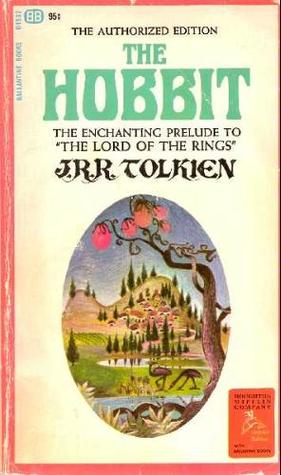
The Hobbit is one of those books I have always intended to read. As a kid, I was deeply disturbed by watching part of the Rankin-Bass movie, and that put me off the entire thing basically until the Lord of the Rings movies came out. Then I was suddenly all about Frodo, and I got very into the whole Tolkien universe. But I still didn’t read The Hobbit. Now, once again, I’m ashamed to say that I’m being motivated to read a book because its movie is coming out. I hope that it saves some face to say that the copy I read was the authorized paperback edition from 1965 and not a 2012 edition with the movie cover, but I’m still pretty ashamed that it took me this long to read a classic.

The Hobbit follows the adventures of reluctant traveler Bilbo Baggins, who is selected by Gandalf to accompany an expedition of dwarves who plan to fight a dragon and win back the treasure they lost years and years ago. As compared with Lord of the Rings, this book is much less dark and less violent. Bilbo does find himself in dangerous situations fairly often, but even when others around him perish or are injured, he is spared the majority of the pain and suffering. I imagine this is because The Hobbit is intended as a children’s story, and that Tolkien wanted to incorporate excitement and adventure, but without scaring his audience so much they’d want to stop reading.

I enjoy Tolkien’s writing, and even read sections of this book aloud to myself in my empty house to just really appreciate the words and descriptions that he puts together. I was disappointed, though, that this book lacked a lot of the high stakes and subtlety of the Lord of the Rings trilogy. I had gotten the impression somehow that there were more obvious connections between the two stories than I actually found. It was fun to read about Bilbo’s first encounter with Gollum, wherein he comes to possess the ring that causes all that trouble later on, but I had always imagined that Gollum had a huge role in The Hobbit, and in reality he gets just one chapter. I was thankful for the other characters I got to meet, however, especially Beorn, the large man who can morph into a bear. (He reminded me somewhat of Tom Bombadil, one of my favorite LOTR characters, and I can only hope that they won’t cut Beorn from the film the way they did Tom.) I also have the same affection for Gandalf that I do for Albus Dumbledore. I sighed in relief each time he reappeared in the story, and his relationship with Bilbo is very touching, especially knowing what it will be like in the future stories.

I’m not a fantasy reader, I always say, but The Hobbit is one of those books that everyone should read, regardless of the genre you feel most comfortable with. It’s a bit dense for inexperienced readers to enjoy alone, but it would be a perfect family read-aloud. Kids like stories about defeating dragons, and Bilbo is child-like enough that kids can imagine themselves in his shoes and follow him on his journey. The nice thing about fantasy titles, too, is that they don’t get dated as quickly as realistic fiction titles. The world Tolkien has created can always exist in our imaginations, without the worry that some modern technology will change the way we think of it.

Anyone taking a child to see the first The Hobbit film this holiday season should definitely share the book with that child first. Kids who love Ranger’s Apprentice, Harry Potter, Last Apprentice, and Septimus Heap will feel right at home in Bilbo’s world, but many other types of readers can find something to love about it as well.

Sunday, November 25, 2012

Book Review: Eleven Kids, One Summer by Ann M. Martin (1991)

Eleven Kids, One Summer is the sequel to one of my favorite books from childhood, Ten Kids No Pets. Looking back, I remember the first book as the better of the two, but reading them both again as an adult, this sequel is the story that won me over. Keegan, the youngest in the Rosso family, is now six months old, and the family is taking a vacation to Fire Island, where they will stay in a beach house. As the summer passes, each of the kids has an adventure involving everything from fishermen and haunted houses to movie sets and romances.

Here’s what made me love this book:
  • While each of the kids has his or her own adventure, some of the adventures overlap. For example, Candy’s chapter early in the book introduces a haunted house plot that reappears in Hannah’s chapter and Hardy’s chapter in the middle and end of the book. Woody also becomes an entrepreneur in his chapter, which influences things that happen to Bainbridge later on. This interconnectedness made me feel like I was living amongst the Rossos during their vacation, and even when some of the kids were not heavily featured in a chapter, the ongoing plot threads gave me an idea of where they were and what they were doing.
  • Justin Hart, the romantic hero in Ann M. Martin’s romance novel, Just a Summer Romance, as well as the heroine from that story, Melanie, reappear in this book. I read Just a Summer Romance when I was in ninth or tenth grade, and by then I’d forgotten the details of Eleven Kids, One Summer, so I never made the connection until now. I remember really liking those characters, though, and it was nice to check in with them. 
  • Eleven Kids, One Summer has everything in it that I loved about the various plots of the Baby-sitters Club books- a big family, a ghost story, lots of kids of all different ages, movie stars, twins, a hospital visit and a summer vacation. The Publishers Weekly blurb on the back cover of the book says that Ann M. Martin “knows well what pleases young readers” and I would so agree with that statement. She knows how to keep the pages turning and how to create adventures out of seemingly everyday experiences.
  • This book reminds me of The Penderwicks series, and especially of The Penderwicks at Point Mouette. Abbie Rosso and Rosalind Penderwick are both wonderful big sisters, and the younger Rosso siblings all reminded me of Skye, Jane, and Batty at different points. Both books evoke a timeless sense of childhood innocence and the they celebrate the joys of imagination and independent play. Eleven Kids, One Summer was published 14 years ahead of the first Penderwicks book, but they both feel equally contemporary in style and content.
Eleven Kids, One Summer is a perfect example of Ann M. Martin’s talent for creating unique kids and making each different personality relatable for her readers. Reviews from when the book was published were not particularly kind - especially one from School Library Journal that said “signs of formulaic contemporary sit-com fiction are in abundance” in the book, and that “sometimes the pace and content strain credibility.” I think this book is actually heads above many of those poorly written sit-com books, and maybe not everything that happens is likely to happen in real life, but it worked well in the fiction.

Eleven Kids, One Summer is out of print, which makes me sad, but there is obviously still some love for the Rossos, since copies of their books are quite expensive (over 140 dollars!) on Amazon. I think this book brings about heavily nostalgic feelings for a lot of kids of the 90s. I know it does for me.

Sunday, November 18, 2012

Book Review: Angie's First Case by Donald Sobol

Donald Sobol is known to most people as the author of the popular Encyclopedia Brown series, of which there are more than 25 titles. What I didn’t realize is that Sobol actually wrote 65 books in all, and that some of them are about girls. Angie’s First Case, which was published in 1981, is the story of a 12-year-old girl who lost her parents at a young age. She and her older sister, Kit, live with their aunt, who doesn’t have much money, so Kit has given up the idea of college to become a police officer. Kit loves her work, but Angie is convinced that her sister could get promoted and be even happier if Angie helps her crack a major case. Every day, Angie goes out jogging in the hopes of catching a band of teen thieves known as the Wolfpack. One day, while she is out with Jess, a chubby boy she likes, Angie sees a series of suspicious events. By witnessing these strange occurrences, Angie sets herself up to become a kidnapping victim as well as a hero.

This book is unlike any other middle grade mystery novel I have ever read. It is mainly plot-driven, like the Encyclopedia Brown mysteries, but the characters are strongly developed in the first couple of chapters so that the reader roots for their success as much as for the downfall of the bad guys. There is a hint of romance between Angie and Jess, but it is restricted to holding hands, which is very sweet and keeps the love angle from taking over the action and adventure that is the true focus of the story. The absence of all the technologies we use today requires Angie to rely on her wits to solve the mystery, which always makes a tale like this more exciting. There were a couple of points where I found myself thinking how much easier things would be if the kids did have phones, but I liked the added challenges and the ingenious plans the kids enact to overcome them.

Though Sobol is great at delivering clues and other case-related information in a straightforward manner, he also has some great descriptions that evoke Angie’s emotions and thoughts at certain points in the story. One of my favorites is this moment, where Angie watches Kit put her gun away at the end of the work day.

…[Kit] folded the ten-pound gun belt with its holster, gun, and two pouches of ammunition. The black patent leather gleamed in a ray of evening sunlight.

Angie sat stiffly. The handgun fascinated her. It was .38, fast-loading, six-shot pistol with a dark wood panel inlaid on each side of the handle.

Now it rested snugly in the holster. Yet its deadliness worked eerily on Angie’s mind. The gun seemed much larger than its actual size. She was amazed when it disappeared into the dresser drawer so easily.


This passage conveys the power of the gun, Kit’s carefulness with it, and Angie’s sense of awe surrounding the gun and her sister’s important job.

Also charming is the accompanying illustration for this same chapter:

I love Aunt Velma peeking out at the girls from the living room, and Angie’s completely 80s hair and outfit. I also think it’s sweet that Kit is leaning down to kiss her sister.

This illustration is by Gail Owens, who also illustrated some of the the Encyclopedia Brown books and other books by well-known 80s children’s authors like Johanna Hurwitz, Phyllis Reynolds Naylor, and Caroline Cooney. Owens was also the illustrator of The Cybil War by Betsy Byars.

I was really impressed by this book and I wonder why Sobol never returned to Angie’s life to tell us of her future cases. It seems like he focused almost exclusively on Encyclopedia Brown in the later years of his career, which makes sense, since they were so popular, but I fell in love with Angie in this book, and I wish there were more mysteries featuring her!

Angie’s First Case is out of print, but copies abound on Amazon. Personally, I think it’s as relevant now as the Encyclopedia Brown books and would love to see it become widely available once again!

Sunday, November 4, 2012

Book Review: We Didn't Mean to Go to Sea by Arthur Ransome (1937)

In We Didn’t Mean to Go to Sea, the Walker children and their mother are waiting at Pin Mill for Daddy to arrive home when they meet a young sailor named Jim Brading. Jim promises to sail the kids around to a few of the nearby ports, giving Mrs. Walker his word that he will not take John, Susan, Titty, and Roger to sea. He doesn’t anticipate the fact that he will run out of petrol, or that a heavy fog will descend over his boat, The Goblin. Nor does he guess that the tide will turn and the Walkers will drift out to sea in his boat, heading for Holland with no captain and no idea how they will get home.

My big frustration with the last book, Pigeon Post, was that I had trouble buying into the make-believe adventures of the Walkers and the Blacketts. For the first time, imagined adventure didn’t seem like enough. I’m so glad that this seventh book in the series finally allows these characters to experience something real. I was a bit disappointed, at first, that the Blacketts do not appear in this book, but even their absence was somewhat refreshing. Without Nancy to call the shots, the other characters are forced into leadership roles, which provides a lot of really nice character development for both John and Susan. Even Titty and Roger show signs of growing up as the story progresses.

What really impressed me the most about We Didn’t Mean to Go to Sea is that Ransome manages to keep things exciting for the duration of the book, despite the fact that 90% of it takes place on board the same boat. Weather, seasickness, and passing ships provide the required drama to propel the story forward even when all the characters are doing, essentially, is waiting to reach port and agonizing over what their mother will say when she learns they disobeyed. Ransome’s writing is never dull, and the ending of this story, when they finally find a way home, is one of the most satisfying endings of the entire series. It almost feels like a finale, and though I have started the next book and I’m enjoying it, I still think We Didn’t Mean to Go to Sea could have served as the perfect conclusion to the Walkers’ stories. It is the perfect culmination of all their training as sailors and in some ways, the full realization of the fantasy constructed in Peter Duck.

I can’t name many authors whose writing is consistently wonderful over the course many books, but Ransome is such an author. I like the way his stories continue to expand upon the vast universe he has created, and I enjoy the way he tempers every moment of high stress and danger in his stories with a warm moment of comfort among family and friends. We Didn’t Mean to Go to Sea ranks high on my list of favorites in this series, right beside Swallowdale and Winter Holiday.

Sunday, October 28, 2012

Book Review: Bright Island by Mabel L. Robinson (1937)

Thankful Curtis is the youngest of Mary Curtis’s children and the only girl. Her six brothers have married and left the family home on Bright Island, but Thankful has no such desires. She wants to remain in the place she loves most, where she can hold tightly to memories of her beloved grandfather. Unfortunately, Thankful’s family is concerned that she hasn’t been properly educated about “what a girl is for,” so they decide that she must attend school on the mainland. In the year that follows, Thankful learns the ways of the modern world, which has many more luxuries than her island home, and comes to a greater understanding of herself as a human being.

Bright Island was originally published in 1937, and it was a 1938 Newbery Honor book. It seems that it has been out of print for a while, but Random House has just published a 75th anniversary edition, which I read courtesy of NetGalley. Bright Island is a coming of age story of a type that no one seems to write anymore. Thankful’s age is never identified, but based on her experiences at school, she must be a teenager, meaning this book would likely be classified as YA if it were published today. It certainly shares a lot in common with other young adult books. Thankful struggles with issues of family, identity, friendship, education, romance, and belonging. She must leave the safety of everything she knows and try to stay true to herself out in the real world. This is something every teen faces, either at the start of high school, or when he or she goes away to college.

The writing, despite being 75 years old, is very accessible. Robinson’s lyrical prose is beautiful - especially to read aloud - but the reader doesn’t get bogged down in her descriptions, as in other older books (The Yearling, for example.) Thankful and her mother are the strongest characters in the book, but even more minor characters, like Thankful’s antagonistic roommate, are written sympathetically, so the reader understands their motivations and believes in them as real people. The most interesting parts of the plot actually hinge on the visits of these minor characters to Bright Island. These scenes heighten the tensions between Thankful's island life and the modern world on the mainland and show the reader interesting sides to Thankful's character as well as that of her roommate and of Robert, a popular boy from school.

I expected this book to be similar to Swallows and Amazons, but Bright Island is much more character-driven. There are some sailing scenes, and I was thankful that I had read Swallows and Amazons because that helped with the sailing terminology, but this is not a sailing book, or even an island book. The island is a strong presence because of its importance to Thankful, but Thankful herself is really the center of the plot. It is through her experiences that the reader comes to terms with the inevitable, which is that we will all someday grow up and venture out into the world.

The illustrations by Lynd Ward are a wonderful addition to the story. They look old-fashioned by today's standards, but they do a wonderful job of immersing the reader into the natural world Robinson conveys with her words. I think my favorite image of the entire book is  the snowy illustration at the start of the chapter entitled "The Stranger Leaves Bright Island." I love the way Ward draws the sweep of the winter wind and each individual snowflake. I get cold just looking at the picture.

Bright Island should appeal to girls - and maybe boys, too - who like reading classic works of children’s literature. I think it would make a wonderful read for a mother-daughter book club, as the mother-daughter relationship is one of the central themes. Some read-alikes might include The Little House on the Prairie series, In Summer Light by Zibby O’Neal, and The Moon By Night by Madeleine L’Engle.

Sunday, October 14, 2012

Book Review: Pigeon Post by Arthur Ransome (1936)

It’s summertime once again, and Nancy has a new project - prospecting for gold on High Topps. Unfortunately, there’s a drought going on, so the camping place she had in mind doesn’t have any water, and the whole team of prospectors is forced to stay at Mrs. Tyson’s farm, with Mrs. Tyson cooking the meals and supervising their every move. Nancy and her friends can’t stand not being able to do things for themselves, so they begin looking for ways to get out of this highly native situation. It looks hopeless at first, but then Titty takes up dowsing, Roger finds a hidden cave filled with gold, and Squashy Hat, a mysterious gentleman staying at another nearby farm seems to be up to something, making him the perfect enemy. Everything will be perfect, if only they can make a gold ingot to show Captain Flint when he returns from sea.

I had really high expectations for Pigeon Post, both because it’s an award winner, and because it once again brings together all three main groups of characters in the Ransome universe - the Swallows, the Amazons, and the Ds. Unfortunately, this book has the slowest start of any of the Swallows and Amazons series. I liked the introduction of the homing pigeons at the start of the story, and Dick’s ingenious system for alerting Mrs. Blackett when they arrive with messages, but I was confused by Titty’s weird reaction to her dowsing abilities. I liked seeing Nancy and company overcome the challenges presented by the drought, but I never for a second believed there could be gold, or that Squashy Hat could be looking for it. I spent the first three-quarters of the book waiting for it to get good, and finding it impossible to suspend my disbelief. This was the first time I couldn’t imagine along with the characters, and it really annoyed me to feel like the series had betrayed me by creating a situation where I couldn’t buy into the game.

Thankfully, after pages and pages of wishing for the good stuff, I was rewarded handsomely. The ending of this book is by far the most exciting of any in the series so far, and it puts the characters in the most danger they have ever been in. The entire last eighth of the book is so good it makes up for all the weirdness with the dowsing and the boring digging and smelting processes. Also, looking back on the book after finishing it, I also noticed some nice character development that has progressed over the course of the series. The fact that these characters who once could only dream of sleeping on Wild Cat Island can now build a well and a furnace shows that the characters are growing and maturing over time. This aging process is most obvious in Roger, who, for the first time, discovers the most important find of the whole summer - the cave containing the gold. While each book of the series is mostly self-contained, I love being able to see the picture and watching the kids grow up more and more with each book.

Besides Peter Duck, Pigeon Post is currently my least favorite of the series. I just didn’t get most of it, and if not for the great ending, I would have been disappointed that I wasted my time. I am very curious about the next book, We Didn’t Mean To Go To Sea, and I hope it promises more real, rather than imagined, adventure.