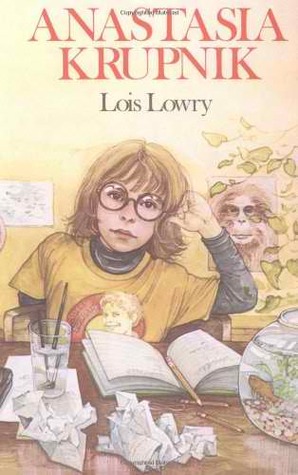
Anastasia Krupnik keeps an ever-changing list of things she likes and hates. Sometimes she hates her grandmother for losing her memory and not knowing who she is. Other times, she loves the opportunity to sit down and get to know her better. Sometimes she loves Washburn Cummings, an older boy in her neighborhood, and other times, he makes her so unhappy she adds him to the hate list. Her teacher, her parents, and even her soon-to-be-born baby brother all jump back and forth between the lists as Anastasia navigates life as a ten-year-old.
I remember the Anastasia books from childhood, but I couldn't swear that I've ever read one. As a kid, I tended to be turned off by older books, and I think this series has always had an unfortunate set of covers that make the stories seem even older than they actually are. Reading it now, as an adult, this book was a surprise. I was surprised by the fresh writing and the main character's strong voice, and I was surprised by how quickly the story moves, and how easy it was to get lost in it. There isn't much of a plot, really, but what makes the book stand out are all the great details Lowry uses to paint the Krupniks as real people. I loved learning about Anastasia's father, Myron, through the dedication pages in each of the poetry books he has written. I loved Anastasia's brief flirtation with the idea of becoming Catholic, and her impression of what that would mean. Anastasia's family life reminds me of many other families from middle grade series, including the Clementine, Ramona Quimby, and Alice McKinley books. Somehow I've never thought of the Anastasia books as being in the same class with these "classics" - but I should have guessed that Lowry would write just as well in the realistic fiction genre as she does in science fiction.
Anastasia Krupnik will appeal to fans of the books I just mentioned, as well as to readers who like Johanna Hurwitz, Ann M. Martin, and Megan McDonald. It's tricky for me to promote books to kids when their covers look so old and strange, but it's worth giving them a great book talk - or even reading one aloud to a group in order to get kids excited about reading them once again. Very little stands between Anastasia and 21st century girls, and I'm not even sure anyone could tell just from the text that this book is older than I am! If you missed these in childhood, as I did, give them a try now - you won't be disappointed.
Sunday, March 31, 2013
Sunday, March 24, 2013
Book Review: The Big Six by Arthur Ransome (1940)
In the eight books of the Swallows and Amazons series published prior to The Big Six, Arthur Ransome’s wonderful characters have imagined themselves in a whole host of situations. Sometimes they are sailors; at other times, they’re miners, at still other times, they’re explorers. This time around, the Death and Glories (Joe, Bill, and Pete) and Tom Dudgeon as well as Dick and Dorothea, fancy themselves detectives, and they’re not too far off from becoming the real thing. Someone has been casting off boats, and almost everyone believes it is the Death and Glories. They have been in the vicinity of each boat set adrift, and Mr. Tedder, the local policeman is sure he will be able to prove it was them and disband the Coot Club. Dorothea, with her wild imagination, and Dick, with his new interest in photography team up to help their friends prove their innocence and catch the real culprit.
While I will always love the Swallows the most of all of Ransome’s characters, I really grew to love the Death and Glories in this book. In their first appearance, back in Coot Club, the three boys seemed very much like one entity, with very few obvious details to differentiate one from another. In this book, the three boys’ individual personalities are much more pronounced, and I enjoyed seeing the ways they related to one another. I also enjoyed seeing Dick and Dorothea in leadership roles in this story. In all the previous books they have been in, it seems like they have always taken their cues from someone else - namely Nancy, Tom, or Mrs. Barrable. To see them as heroes in this book was a nice change of pace. I also thought it was neat to introduce a mystery element into a sailing story, and I didn’t miss the technical sailing jargon that seems to permeate most of Ransome’s other writing.
I am now just three books away from completing this series, and The Big Six is definitely among my favorites of all the books. At some points, the repetition of the evidence and the lack of action is a bit tedious, but for the most part, the fresh dialogue keeps things moving, and the slow revelations about the different clues help to build suspense so that the reader doesn’t know the outcome of the mystery until the absolute last second. Though the reader can easily guess early on who the true criminal is, it is still entertaining to see the kids solve the mystery and prove their case even when none of the adults around them could manage. Just like all the other Swallows and Amazons books, this one celebrates what kids can do on their own and proves that they should be taken just as seriously as adults.
While I will always love the Swallows the most of all of Ransome’s characters, I really grew to love the Death and Glories in this book. In their first appearance, back in Coot Club, the three boys seemed very much like one entity, with very few obvious details to differentiate one from another. In this book, the three boys’ individual personalities are much more pronounced, and I enjoyed seeing the ways they related to one another. I also enjoyed seeing Dick and Dorothea in leadership roles in this story. In all the previous books they have been in, it seems like they have always taken their cues from someone else - namely Nancy, Tom, or Mrs. Barrable. To see them as heroes in this book was a nice change of pace. I also thought it was neat to introduce a mystery element into a sailing story, and I didn’t miss the technical sailing jargon that seems to permeate most of Ransome’s other writing.
I am now just three books away from completing this series, and The Big Six is definitely among my favorites of all the books. At some points, the repetition of the evidence and the lack of action is a bit tedious, but for the most part, the fresh dialogue keeps things moving, and the slow revelations about the different clues help to build suspense so that the reader doesn’t know the outcome of the mystery until the absolute last second. Though the reader can easily guess early on who the true criminal is, it is still entertaining to see the kids solve the mystery and prove their case even when none of the adults around them could manage. Just like all the other Swallows and Amazons books, this one celebrates what kids can do on their own and proves that they should be taken just as seriously as adults.
Sunday, March 17, 2013
Reading Through History: The All-of-a-Kind Family by Sydney Taylor (1951)
Mama has five girls: Ella, Henny, Sarah, Charlotte, and Gertie, and because there are no boys, they call themselves an “all-of-a-kind family.” The family doesn’t have very much money, but they still have lots to be happy about. The girls visit the library regularly, where they are always glad to see their friend, the library lady. They have a wonderful relationship with their father’s best friend, Charlie, who gives them treats when they are sick and often comes around for dinner on holidays. They even get a little bit of money now and then to spend on secret candy to eat in bed, and to buy gifts for their father’s birthday. Throughout the year, the girls keep busy and make the best of what they do have - wonderful friends, and each other.This first book in the All-of-a-Kind-Family series was written in the 1950s, but it takes place during the year 1912. Despite the age of the story and the fact that it is historical fiction, it is a fresh and accessible book, even today. Though the girls in the story are poor and living on the Lower East Side of Manhattan, they have many experiences that can be universally appreciated by children from all backgrounds, living in urban and rural environments. Each chapter consists of a particularly memorable episode in the family’s life, including things like the loss of a library book, the discovery of old books in their father’s warehouse, and missing out on the Passover seder because of scarlet fever. Readers learn not only what life was like for immigrants living in early 20th century New York, but also all about Jewish tradition and celebrations throughout the year. Though the girls in the story lived 100 years ago, they have many qualities, interests, and worries that contemporary kids undoubtedly share.
The All-of-a-Kind Family is a great fictional representation of growing up in a Jewish family, as well as a sweet celebration of sisterhood. There are some surprise twists at the end of the book that bring together details and characters from earlier chapters, and I didn’t see any of those coming, so I was very pleased by that. I also like how quickly the story moves, and the upbeat tone that provides a sense of hope in difficult circumstances without becoming overly sentimental about city living or poverty. Readers who are anxiously awaiting another installment in the Penderwicks series might enjoy reading about the All-of-a-Kind Family - a series with six books in all - while they wait. It might also appeal to fans of Megan McDonald’s Sisters Club books, and to readers who enjoy The Boxcar Children, The Bobbsey Twins, and Betsy-Tacy.
Sunday, March 10, 2013
Book Review: The Railway Children by E. Nesbit (1906)
Roberta (Bobbie), Peter, and Phyllis (Phil) have never been poor before, but when their father must go away unexpectedly, they and their mother move to a more modest home in the country. There isn’t much to do in their new, smaller house, and their mother is always busy writing stories to make ends meet, so the children often find themselves visiting the railway station. There they have many adventures: making friends with Perks the porter, waving to a particular old gentleman who rides the train past their station every day, and even saving a train from a very bad accident! All the while the three children are kept in the dark about where their father really is. When Bobbie finds out by mistake, she uses her railway connections to sort things out and, hopefully, bring her father home.
My husband has been nagging me to read this book for months, and I kept putting it off because I was one hundred percent sure it was an old, sad orphan story. I was completely wrong about this, as it turns out. There is some sadness in the book, but the kids are not orphans, and though the story is now over 100 years old, it reads more like a 1950s children’s novel, such as those written by Eleanor Estes and Elizabeth Enright. It is certainly somewhat old-fashioned compared to contemporary middle grade novels - the children dress in early 1900s garb, they watch a “paper chase” in one chapter, and they lack the modern sources of news and communication that would have made it much easier for them to learn of their father’s whereabouts during his long absence. The narrator also sometimes addresses the reader directly, which is not very common in contemporary kids’ books (unless they’re written by Lemony Snicket.) Even so, the dialogue between the characters sounds very contemporary, and many of the children’s arguments and conversations could easily happen in any group of 21st century children I have met.
The story itself is well-written without being difficult to read. The characters come vividly to life mostly in the way they speak, and each chapter’s adventure moves swiftly by. It is extremely unlikely that any group of kids would have so many opportunities to save lives and cheer up those in need, and it did bother me toward the end of the book that a country town where nothing ever happens could suddenly be the center of so much excitement. Still, kids reading this book would no doubt enjoy seeing kids their own age becoming heroes, no matter how unlikely those events might actually be. They will also relate to the kids’ desire not to seem like pious goody-goodies, and to the mistakes they make along the way.
The Railway Children is to railroads what Swallows and Amazons is to sailboats. Any child who has ever been fascinated by trains will fall in love with the railway station along with Bobbie, Peter, and Phil, and they will enjoy feeling like part of their family. Recommend The Railway Children to realistic fiction readers who enjoy family stories, adventure, and emotional happy endings.
My husband has been nagging me to read this book for months, and I kept putting it off because I was one hundred percent sure it was an old, sad orphan story. I was completely wrong about this, as it turns out. There is some sadness in the book, but the kids are not orphans, and though the story is now over 100 years old, it reads more like a 1950s children’s novel, such as those written by Eleanor Estes and Elizabeth Enright. It is certainly somewhat old-fashioned compared to contemporary middle grade novels - the children dress in early 1900s garb, they watch a “paper chase” in one chapter, and they lack the modern sources of news and communication that would have made it much easier for them to learn of their father’s whereabouts during his long absence. The narrator also sometimes addresses the reader directly, which is not very common in contemporary kids’ books (unless they’re written by Lemony Snicket.) Even so, the dialogue between the characters sounds very contemporary, and many of the children’s arguments and conversations could easily happen in any group of 21st century children I have met.
The story itself is well-written without being difficult to read. The characters come vividly to life mostly in the way they speak, and each chapter’s adventure moves swiftly by. It is extremely unlikely that any group of kids would have so many opportunities to save lives and cheer up those in need, and it did bother me toward the end of the book that a country town where nothing ever happens could suddenly be the center of so much excitement. Still, kids reading this book would no doubt enjoy seeing kids their own age becoming heroes, no matter how unlikely those events might actually be. They will also relate to the kids’ desire not to seem like pious goody-goodies, and to the mistakes they make along the way.
The Railway Children is to railroads what Swallows and Amazons is to sailboats. Any child who has ever been fascinated by trains will fall in love with the railway station along with Bobbie, Peter, and Phil, and they will enjoy feeling like part of their family. Recommend The Railway Children to realistic fiction readers who enjoy family stories, adventure, and emotional happy endings.
Sunday, March 3, 2013
Book Review: Afternoon of the Elves by Janet Taylor Lisle (1989)
This is one of the creepiest children’s books I have ever read. I am so thankful I did not discover it when I was a kid, because I’m not sure I could have handled its eerie tone and unresolved ending. Though this is a realistic fiction book, it’s also something of a psychological thriller. Hillary believes in Sara-Kate’s well-constructed fantasy so thoroughly that she becomes almost blind to the fact that Sara-Kate and her mother are nearly starving to death. She becomes obsessed with the elves to the point that she continues visiting them after Sara-Kate is gone, and she becomes distant from her own friends and rebellious towards her mother. Sara-Kate’s house is described using details one would attribute to a haunted house, and a little shiver of fear and anticipation went up my spine each time Hillary thought she saw Sara-Kate’s mom appear in the window. When Hillary finally makes her way into that house and sees the state of things inside, I felt like I was watching a horror movie, just waiting for something to jump right out at me. I wouldn’t say I enjoyed it - the whole story actually really freaked me out.
This book was published in 1989, and received a Newbery Honor in 1990, but though it is more than 20 years old, it reads as though it could happen any time. Despite it creepiness, the story does raise a lot of important issues that seem relevant to almost any time period. It shows the way poor families, or families in need of serious help, can sometimes fall through the cracks. It questions whether the help given to such families is adequate or truly helpful. It shows the ways in which traumatized children can cope through fantasies, and even helps Hillary to become her own person, in a very weird way. What makes the book so unsettling is that nothing is neatly resolved. The reader is left to grapple with difficult questions on her own, and to come to her own conclusions, whatever they may be.
Kids can read this book on their own, but I think this is one of those stories that really needs to be shared and discussed so kids can process what they have read. After finishing the book, I didn’t even want to walk around my own house in the dark. It’s that kind of disturbing and eye-opening story, and I think kids who read it will have a lot of their own questions and worried thoughts upon finishing it. It’s a beautifully written novel, and in some ways quite similar to my favorite book by E.L. Konigsburg, Jennifer, Hecate, Macbeth, William McKinley, and Me, Elizabeth, but a feel-good beach read it is not. Recommend it to those strong upper elementary readers looking for a challenge, and to fans of horror stories. Also check out this discussion between the author and a group of students, formerly at her website, and now at Internet Archive, which sheds at least a little bit of light on the story.
Sunday, February 24, 2013
Book Review: Miracles on Maple Hill by Virginia Sorenson (1956)
In contemporary children’s books, there is a tendency to dwell more heavily on the darker side of life. Nowadays, for better or for worse, we trust kids to deal with the harsh truths of life - abuse, poverty, divorce, death - and many books describe these situations in detail, evoking empathy from readers and encouraging them to feel all the associated emotions, good and bad. This book handles the pain of Marly’s dad’s experiences in a more detached way, which I think is an interesting and effective approach.
Marly is about ten years old, and what we know of her dad’s condition is filtered through her point of view. It seems likely, given the personality of her mother, that Marly would be protected as much as possible from the darkness of her father’s experiences. Because of this, the reader is really only shown those few frightening moments of anger that Marly has actually witnessed. Throughout the book, both Marly and her brother react to their father nervously, with lots of concern over how he will respond to them, but the reader isn’t subjected to the experiences that made them feel that way. I can only assume this was a conscious decision on the part of the author, and my guess is that it was a decision made to protect young readers. Though some kids do certainly like to read the gory details, or maybe even need to read them to feel validated, other kids are more sheltered, like I was, and this book strikes a great compromise between perfect happiness and interesting storytelling.
The other remarkable thing about this book is its descriptions of country living. I borrowed this book from my urban library system, where kids don’t often run into wildflowers, wild mushrooms, or sap from maple trees. If they read this book, though, they will feel as though they have spent a year on Maple Hill right alongside Marly. The descriptions of everything Marly sees, feels, and tastes during her year of visits to Maple Hill are beautiful, and the author uses just the right details to transport the reader through the beauty of the different seasons. She ties all of this wonderful information about the natural world in with Marly’s relationship with her brother, Joe, and both kids’ relationships to their Maple Hill neighbors, and it is the combination of character and setting that drives the story forward.
This is very much of a book of the 1950s. There are lots of references to very rigidly defined gender roles, where Joe is permitted many freedoms, but Marly must stick close to home, and where it is surprising when Marly’s father learns to cook, or when her mother drives the family car. At one point, Marly’s mother actually apologizes to Marly’s teacher because Marly is more of a tomboy than the other girls at her one-room schoolhouse. These references are among the few moments in the story that make it seem more historical than contemporary. There are also a lot of references to Marly’s father’s time in World War II, which could date the book, but given that our country is also at war today, it is possible that contemporary kids could have a parent in a similar situation to Marly’s father and find some hope and meaning in his recovery.
I really enjoyed this book, though it’s probably best enjoyed when we think of it as “old” realistic fiction rather than historical fiction. The story reflects the values of the time, but they have not been filtered through contemporary thinking. Two very recent novels about similar subjects that might draw interesting comparisons are The Second Life of Abigail Walker by Frances O’Roark Dowell and The Bell Bandit by Jacqueline Davies.
Friday, February 22, 2013
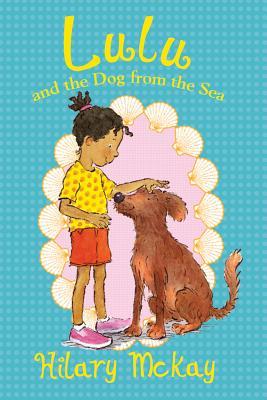
Book Review: Lulu and the Dog from the Sea by Hilary McKay (2013)
Lulu and the Dog from the Sea is Hilary McKay’s second adventure about a young animal lover whose compassion for animals in need often leads her into trouble. Set during the summer, this story takes place at the beach, where Lulu and her family take a vacation with Lulu’s best friend Mellie. On their first day in their vacation home, Lulu is warned not to befriend a stray dog who wreaks havoc on the neighborhood by digging through everyone’s garbage cans, but she just can’t help herself. The dog from the sea is obviously lonely - and hungry. Lulu is overwhelmed by the desire to save him, but to do so, she’ll have to protect him from the local dog catcher as well as from angry neighbors who would do him harm. A subplot involves Mellie’s difficulties with building a kite, the end result of which figures heavily into the fate of Lulu’s new canine friend.
For more than two thirds of the story, I liked this book better than its predecessor, Lulu and the Duck in the Park. Whereas the first story focuses mostly on Lulu and her class at school, this second one delves deeper into her family dynamics, and into the personalities of Lulu’s parents. Occasionally, it shifts points of view so we get to understand the thoughts of Lulu’s own dog as well as the so-called dog from the sea. Lulu’s empathy for animals gets transferred to the reader so that, dog lover or not, the reader becomes invested in the well being of this particular stray dog. The writing is strong and evocative, and at times, even funny. In particular, I enjoyed the moment in chapter three when Lulu’s dog Sam reflects on the ill behavior of other dogs, and the narrator tells us that Sam would be surprised to learn that he himself is a dog. I also loved McKay’s descriptions of the beach atmosphere. I felt as though I could practically breathe the sea air.
There is just one problem with this book, and for me, it was sort of a deal breaker. In the final moments of the story, when the tension mounts between the dog from the sea and his neighbors, the dog suddenly becomes Lassie. In episode after episode of Lassie, the famous collie has a sixth sense about his master, Timmy, and she is always running off to wells and mines and various dangerous places to rescue him. Essentially the same thing happens near the end of this book. I saw it coming, hoped desperately that it wouldn’t happen, and then found myself rolling my eyes as the book jumped the shark in a way I could not really forgive. Will kids who love dogs find the ending believable? Perhaps. This series is very sweet and gentle, and readers who don’t mind a mushy ending might buy into the easy way things wrap up for Lulu and the dog from the sea. For me, though, having read many chapter books, I thought this was too simple an ending to an otherwise beautifully written book. I felt that the author owed the reader a more realistic and less cliched finale, and it dropped my Goodreads rating from five stars down to three.
Lulu and the Dog from the Sea is likely to appeal to fans of the first Lulu book, as well as to readers who like the Puppy Place, Vet Volunteers, and Critter Club series. It’s also a nice family-oriented alternative to some of the other girl-centric chapter book series where crushes and girl drama have taken center stage.
For more than two thirds of the story, I liked this book better than its predecessor, Lulu and the Duck in the Park. Whereas the first story focuses mostly on Lulu and her class at school, this second one delves deeper into her family dynamics, and into the personalities of Lulu’s parents. Occasionally, it shifts points of view so we get to understand the thoughts of Lulu’s own dog as well as the so-called dog from the sea. Lulu’s empathy for animals gets transferred to the reader so that, dog lover or not, the reader becomes invested in the well being of this particular stray dog. The writing is strong and evocative, and at times, even funny. In particular, I enjoyed the moment in chapter three when Lulu’s dog Sam reflects on the ill behavior of other dogs, and the narrator tells us that Sam would be surprised to learn that he himself is a dog. I also loved McKay’s descriptions of the beach atmosphere. I felt as though I could practically breathe the sea air.
There is just one problem with this book, and for me, it was sort of a deal breaker. In the final moments of the story, when the tension mounts between the dog from the sea and his neighbors, the dog suddenly becomes Lassie. In episode after episode of Lassie, the famous collie has a sixth sense about his master, Timmy, and she is always running off to wells and mines and various dangerous places to rescue him. Essentially the same thing happens near the end of this book. I saw it coming, hoped desperately that it wouldn’t happen, and then found myself rolling my eyes as the book jumped the shark in a way I could not really forgive. Will kids who love dogs find the ending believable? Perhaps. This series is very sweet and gentle, and readers who don’t mind a mushy ending might buy into the easy way things wrap up for Lulu and the dog from the sea. For me, though, having read many chapter books, I thought this was too simple an ending to an otherwise beautifully written book. I felt that the author owed the reader a more realistic and less cliched finale, and it dropped my Goodreads rating from five stars down to three.
Lulu and the Dog from the Sea is likely to appeal to fans of the first Lulu book, as well as to readers who like the Puppy Place, Vet Volunteers, and Critter Club series. It’s also a nice family-oriented alternative to some of the other girl-centric chapter book series where crushes and girl drama have taken center stage.
Subscribe to:
Posts (Atom)