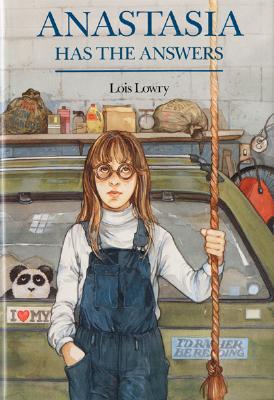
In the sixth novel of the series Anastasia Krupnik is asking the important questions: who, what , where, when, why, and how. The answers ought to be simple enough, but things are complicated for Anastasia by her adoration for her gym teacher, her inability to climb ropes like the rest of her classmates and her little brother Sam’s fascination with reenacting the funeral of their recently deceased aunt.
I feel like I repeat myself a lot in my posts about this series, but each addition is truly every bit as enjoyable as the last. The dialogue is spot-on, the characters are memorable and believable, and Anastasia’s positive attitude and sense of humor in the face of adolescent embarrassment are both entertaining and comforting. I was struck this time by how much I enjoyed Sam’s strangeness, and I found myself laughing out loud each time he found a new way of reenacting his aunt’s funeral procession and burial. This might seem morbid, but it rings perfectly true for Sam’s age and personality, and for the overall tone of the series.
As a person who hated gym class as a teenager, I would have related strongly to this book had I read it in seventh or eighth grade. I also loved the fact that Anastasia’s gym teacher wears a sweatshirt bearing the name of my alma mater, Vassar College. The overall sensibility of the story is still very dated, but Anastasia’s awkward adolescent experiences are universal, and with the right book talk, I think certain kids could still be sold on the series. It would really help, though, if the books could get some decent new covers.
Sunday, May 18, 2014
Monday, May 12, 2014
Book Review: Steering Toward Normal by Rebecca Petruck (2014)

In his eighth grade year, Diggy Lawson raises a steer for a 4-H competition while coming to terms with the discovery that his father has another son.
This wonderful upper middle grade novel tells a touching family story, but without drowning its readers in sentimentality. Diggy’s love for his father, his steer, and later, for Wayne, the brother he never knew about, are the driving forces of the story, presented realistically and with a heavy dose of humor. The story is structured based on the growth of Diggy’s steer, which helps the plot unfold naturally and logically, and Diggy himself is such a well-rounded character, the reader sympathizes with him instantly and finds many reasons to root for him, both in the 4-H contest, and in life. The supporting characters in this book are a colorful bunch, the kind of characters who could make readers want to live inside this book. Chief among these is Pop, Diggy’s delightfully immature 30-something dad whose parenting style involves more practical jokes than true discipline.
Steering Toward Normal, while especially appealing to 4-H members, is by no means restricted to kids who raise their own animals. Diggy’s emotional journey as he makes peace with his dad’s past, his mother’s choices, and his new brother’s presence, is a story any reader can appreciate, and one well worth making available for readers ages 11-14.
Read-alikes for Steering Toward Normal include Project Mulberry by Linda Sue Park and Dairy Queen by Catherine Gilbert Murdock.
Sunday, May 11, 2014
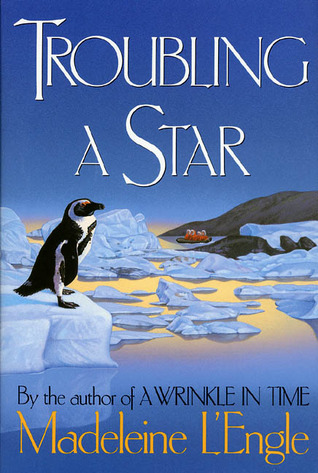
Book Review: Troubling a Star by Madeleine L'Engle (1994)
Now that I have read all of the Murry, O'Keefe, and Austin books, some of the stories very clearly stand out as the best, while others are obviously the worst. Troubling a Star falls somewhere near the bottom of the heap. L'Engle creates this strange sense of false suspense. I could tell I was supposed to be eagerly anticipating a big bombshell ending, but I never actually felt that sense of urgency. Truth be told, from the time Vicky left home, I was bored and kept checking to see just how many pages I had left to read.
Though I adore Vicky in the early Austin books, in this story she was less of a character and more of a vehicle for allowing the reader to witness events in Antarctica. I constantly kept forgetting that she was Vicky and not Polly, as the two characters basically become interchangeable by the end of the series. I really wish L'Engle had stuck to the more realistic family stories such as The Moon By Night. Even The Young Unicorns, which involves some implausible dangers, is more interesting than this cross between Dragons in the Waters and A House Like a Lotus.
All in all, I am glad to have undertaken this reading exercise, and equally glad to be through with it. I was surprised by how inconsistent L'Engle's writing is over the course of each series, and I couldn't help but wonder whether some of these books would ever find an audience if not for their connection to the beloved A Wrinkle in Time. I appreciate L'Engle's willingness to experiment and try different genres. I just never liked the unshakable feeling that she was often writing fanfiction based on her own earlier works.
Saturday, May 10, 2014
Book Review: Ten Little Babies by Gyo Fujikawa (1989)
A group of babies dwindles from ten to one as they engage in daily activities and lose members to such things as play time, tummy aches, and seasickness in this classic board book.
This is a larger board book, and each illustration fills a two-page spread. It suits a number of popular themes for babies and toddlers including babies, counting, and even family. Gyo Fujikawa’s babies are diverse, mischievous, playful, and full of life. The text is a simple rhyme, but the story is really in the illustrations, where little faces convey everything from delight to outright anger. The babies are both childlike and comically adult, adopting mature stances and facial expressions even as they drink from bottles and dig in the sand. The babies are easy to count on each page, always appearing in formations with plenty of space between one baby and the next. The baby who leaves the group at the end of each verse is also easily identifiable on each spread, and little ones will have fun picking him out each time.
This book is similar to Karen Katz’s Ten Tiny Babies, and to many of the baby board books by Helen Oxenbury in which groups of babies participate in various activities. Mem Fox’s Ten Little Fingers and Ten Little Toes is another perfect readalike. People looking for old-fashioned kids’ books with a classic feel will be thrilled with this one, which feels both timeless and contemporary.
This is a larger board book, and each illustration fills a two-page spread. It suits a number of popular themes for babies and toddlers including babies, counting, and even family. Gyo Fujikawa’s babies are diverse, mischievous, playful, and full of life. The text is a simple rhyme, but the story is really in the illustrations, where little faces convey everything from delight to outright anger. The babies are both childlike and comically adult, adopting mature stances and facial expressions even as they drink from bottles and dig in the sand. The babies are easy to count on each page, always appearing in formations with plenty of space between one baby and the next. The baby who leaves the group at the end of each verse is also easily identifiable on each spread, and little ones will have fun picking him out each time.
This book is similar to Karen Katz’s Ten Tiny Babies, and to many of the baby board books by Helen Oxenbury in which groups of babies participate in various activities. Mem Fox’s Ten Little Fingers and Ten Little Toes is another perfect readalike. People looking for old-fashioned kids’ books with a classic feel will be thrilled with this one, which feels both timeless and contemporary.
Friday, May 9, 2014
Book Review: Fat Boy vs. the Cheerleaders by Geoff Herbach (2014)

In his first YA novel after his trilogy about Felton Reinstein, Geoff Herbach looks on the lighter side with a story about the controversy surrounding the soda vending machine in a high school cafeteria. Gabe, also known as “Chunk,” buys several sodas from the machine each day, both because he is addicted to Mountain Dew Code Red, and because he knows the money he spends helps to fund the school band, of which he is a member. He is horrified, therefore, when he learns that administration has reallocated the soda machine money to the cheerleading squad, without notifying the student body. As a result of this affront, Gabe becomes the unlikely leader of a movement of dorks who come together to reclaim their funding - and their dignity - from the clutches of the popular cheerleaders and their friends.
This book is structured so that the text of the story is actually the transcript of Gabe’s statement to the school principal after he is arrested for his involvement in the movement to win back the soda machine. Though this conceit is not completely necessary, it provides the story with an easy conversational tone that connects the reader closely to Gabe. Gabe himself is a fun character, with just the right mix of angst and humor, and his perceptions of himself are not always positive, but neither does he wallow in misery over his weight for the entire book.
Though the dorks vs. popular kids story has been done a thousand times over, Gabe makes it new again through his unique voice and his relationships with the supporting characters. Especially interesting is Gabe’s grandfather, a former bodybuilder who helps Chunk get into better shape, while also occasionally advising him on his newfound interest in activism. Also significant to the success of this book is its ability to tell a story about bullying without delving into darkness or didacticism.
Unlike Stupid Fast and its sequels, which mainly suit a high school audience, Fat Boy Vs. the Cheerleaders is more appropriate for middle schoolers. Though it pales in comparison to Herbach’s other books, it’s still a solid read and it could appeal to readers who have enjoyed Fat Kid Rules the World, Staying Fat for Sarah Byrnes, and Nerd Camp.
Sunday, May 4, 2014
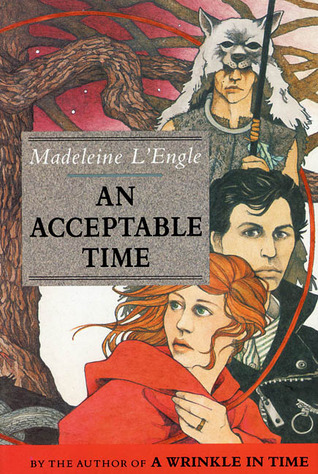
Book Review: An Acceptable Time by Madeleine L'Engle (1989)
In this conclusion to L’Engle’s Time Quintet Polly O’Keefe and Zachary Grey find themselves trapped in a tesseract that allows them to step back in time 3000 years. In the past, they meet The People of the Wind and The People Across the Lake, two primitive societies with differing belief systems. Zachary, who has been told he will die of his heart condition, seeks to be cured by one of the tribe’s healers, while Polly tries to make him understand that the price for this treatment might be her own life.
Like A Swiftly Tilting Planet, this muddled novel was very difficult for me to finish. Polly, who was so emotionally compelling in A House Like a Lotus, is back to her boring Dragons in the Waters self, and Zachary, who has never been interesting, is even less so now that he thinks he is dying. The cast of characters the pair meets 3000 years in the past are not very well differentiated from one another, so I couldn’t keep track of them, and I couldn’t find a reason to be invested in their fate. The Murry grandparents, with whom Polly is staying, who have formerly seemed like courageous and encouraging people, spend this entire book overprotecting Polly and acting like they can’t believe time travel is happening in their own backyard. There is very little consistency in L’Engle’s characters from book to book, anyway, but this is one of the more egregious examples of that problem.
I enjoyed the feeling of things coming full circle that was created by the return of Polly to the place where her mother and later her uncles experienced their own adventures with time, but I was disappointed when L’Engle didn’t somehow bring all those experiences together to mean something greater. It’s very obvious from this story that L’Engle didn’t set out to write a series, and based on how flat this book fell for me, I almost wish she hadn’t!
Like A Swiftly Tilting Planet, this muddled novel was very difficult for me to finish. Polly, who was so emotionally compelling in A House Like a Lotus, is back to her boring Dragons in the Waters self, and Zachary, who has never been interesting, is even less so now that he thinks he is dying. The cast of characters the pair meets 3000 years in the past are not very well differentiated from one another, so I couldn’t keep track of them, and I couldn’t find a reason to be invested in their fate. The Murry grandparents, with whom Polly is staying, who have formerly seemed like courageous and encouraging people, spend this entire book overprotecting Polly and acting like they can’t believe time travel is happening in their own backyard. There is very little consistency in L’Engle’s characters from book to book, anyway, but this is one of the more egregious examples of that problem.
I enjoyed the feeling of things coming full circle that was created by the return of Polly to the place where her mother and later her uncles experienced their own adventures with time, but I was disappointed when L’Engle didn’t somehow bring all those experiences together to mean something greater. It’s very obvious from this story that L’Engle didn’t set out to write a series, and based on how flat this book fell for me, I almost wish she hadn’t!
Sunday, April 27, 2014
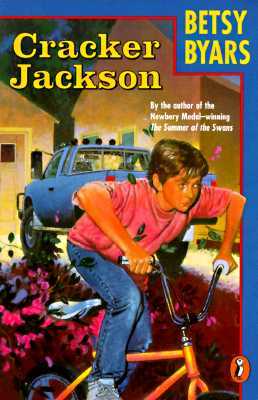
Book Review: Cracker Jackson by Betsy Byars (1985)
Jackson cares a lot about his former babysitter, Alma. This is why he worries so much about her abusive husband, who uses Alma and their baby daughter, Nicole, as physical and emotional punching bags. Though the adults in his life tell him to stay out of it, Jackson can’t help but feel that it is somehow his responsibility to step in and save Alma before her husband does irreparable damage.
This book contains sophisticated subject matter, but it is handled remarkably well, and always in age appropriate terms. Byars strikes the right balance between the seriousness of Alma’s dangerous situation and the humor that boys in the target age range most appreciate. Byars portrays Alma as young, immature, and lost, so that the reader easily sympathizes with her, and she keeps the abusive husband mostly on the sidelines, keeping the threat of violence pretty far removed from her main character. She introduces humor by involving Jackson’s best friend, Goat, and sending the boys and Alma on an ill-fated road trip where the two boys take turns driving.
Byars also strikes just the right balance between the story’s overall message and Jackson’s personal beliefs. Though Jackson always believes he should play the role of hero, the worldview of the story does not reflect this mistaken impression. Rather, Byars makes it possible for the reader to empathize completely with Jackson’s desire to help Alma, but she also makes sure they realize that saving Alma ultimately requires adult intervention.
Jackson is a sincere and believable character to whom most pre-adolescent boys are likely to relate. Cracker Jackson is every bit as well-written as any of the books in the Blossoms series, and readers who enjoyed the high-stakes scenarios in those books will be pleased to find another complicated and realistic story in this book. If this book were published today, it is likely that it would be a dark YA novel with nothing held back. I’m pleased that this book manages to tackle a serious subject without succumbing to darkness, and I wish there were more middle grade novels like it!
This book contains sophisticated subject matter, but it is handled remarkably well, and always in age appropriate terms. Byars strikes the right balance between the seriousness of Alma’s dangerous situation and the humor that boys in the target age range most appreciate. Byars portrays Alma as young, immature, and lost, so that the reader easily sympathizes with her, and she keeps the abusive husband mostly on the sidelines, keeping the threat of violence pretty far removed from her main character. She introduces humor by involving Jackson’s best friend, Goat, and sending the boys and Alma on an ill-fated road trip where the two boys take turns driving.
Byars also strikes just the right balance between the story’s overall message and Jackson’s personal beliefs. Though Jackson always believes he should play the role of hero, the worldview of the story does not reflect this mistaken impression. Rather, Byars makes it possible for the reader to empathize completely with Jackson’s desire to help Alma, but she also makes sure they realize that saving Alma ultimately requires adult intervention.
Jackson is a sincere and believable character to whom most pre-adolescent boys are likely to relate. Cracker Jackson is every bit as well-written as any of the books in the Blossoms series, and readers who enjoyed the high-stakes scenarios in those books will be pleased to find another complicated and realistic story in this book. If this book were published today, it is likely that it would be a dark YA novel with nothing held back. I’m pleased that this book manages to tackle a serious subject without succumbing to darkness, and I wish there were more middle grade novels like it!
Subscribe to:
Posts (Atom)