Sunday, July 15, 2012

Book Review: The Telltale Summer of Tina C. by Lila Perl (1975)

Tina Carstairs is twelve years old, and considers herself a Sad Soul. She and her friends have even formed a club - the Saturday Sad Souls Club - devoted to the improvement of their most egregious flaws. But even though Tina has a twitch that flares up when she’s angry or anxious, that’s not the biggest of her problems. Her mother walked out on the family, moved away, and met a new man. Her father is planning to marry an overly sweet young woman named Rosebud. And Tina’s friends have invited a new girl into their club despite the fact that she doesn’t seem to have any flaws. The only thing that might save Tina’s summer from total disaster is Johann, a sixteen-year-old Dutch tourist she meets in New York City.

The illustration on its front cover and even the blurb on the back of it reduce this book to a frivolous story about a misunderstood adolescent. I realized very early on in the story, however, that this book has much more depth than that. The Telltale Summer of Tina C. is a well-written slice-of-life story about growing up in the 1970s suburbs. Though Tina’s parents are divorced, she is troubled by the idea of blended families, and outright disturbed by the fact that her mother’s new boyfriend does the cooking, while she works all day. Though Tina has some angst - about her twitch and the boys who tease her for it - her life is pretty well sheltered until she has the opportunity to visit New York. The story arc really resembles a coming of age story more than anything else, and Tina is a well-developed, flawed, but lovable protagonist whose emotional experiences are more important than the individual points of the plot.

As I read, I found myself wondering how a twelve-year-old girl of 1975 might react to certain things about this story. Would it seem unusual, or dangerous, for example, for a girl Tina’s age to spend time with a sixteen-year-old boy in a museum, without adult supervision? In 2012, parents would go nuts, I think, imagining all the ways in which an older boy might take advantage of a younger girl, but was society the same way back then? Or did parents feel safer? I also wondered if the underlying discomfort with divorce and remarriage reflected the author’s attitude, or Tina’s, and whether the average reader of this book would have felt the same sense of confusion and dread, or if she would take it in better stride.

I really don’t think a book like this one could be published today. It’s so innocent, and I can imagine a 21st century twelve-year-old finding it tedious and slow-moving. On the other hand, it’s one of the best Apple paperbacks I’ve ever read, and kids who are weary of the darkness of contemporary YA might like to give it a shot. It’s out of print, but copies are available online.

See more posts about this book at Cliquey Pizza: 80's teen book series & pop culture and New York Minknit.  Kirkus’s original review from 1975 is also available here.

Sunday, July 8, 2012

Reading Through History: The Whipping Boy by Sid Fleischman (1986)

The Whipping Boy is a slim historical fiction novel that won the Newbery Medal back in 1987. It’s the story of Prince Horace, also called Prince Brat, who often misbehaves on purpose in order to see his whipping boy, Jemmy, get punished. When the prince runs away and Jemmy follows, they fall in with some criminals and must switch places in order to outsmart them and make their escape.

Of all the relationships presented in children’s books, this one, between a prince and the boy who is punished daily on his behalf, is one of the most unusual and the most interesting. Though the story is mainly an adventure, following the two boys as they try to outsmart a pair of ne’er-do-wells, it also raises a lot of important questions about wealth, status, education, and justice. The prince is rich and powerful, but he has never learned to read or write because he is always busy misbehaving. The whipping boy, however, who can afford to take nothing for granted, has learned the lessons intended for the prince and is fully literate. Inside the castle, the prince’s crown gives him authority; outside the castle walls, Jemmy becomes the powerful one because he can read and write. When the boys trade places, it’s not just a cute Parent Trap-esque plot device. Instead, the swap is used to illustrate the mostly arbitrary societal constructs that separate the haves from the have-nots. The reader learns, without explicitly being taught, that there are different types of riches, and that the last can suddenly be first when circumstances shift and change.

There are many other elements to this book that make it great. I’m sure kids are pleased to see Prince Brat get his comeuppance after Jemmy has endured so many beatings in his stead, but I bet they enjoy his journey toward redemption just as much. Each character the boys meet on their journey back to the castle is colorful and memorable, and the boys’ clever plan for finally escaping their captors makes for a very satisfying ending.

This book reminds me a lot of The Tale of Despereaux, and I think fans of one will equally enjoy the other. It’s also a nice, quick read with lots of action that a reluctant reader might be willing to try over something longer and more intimidating. I like Sid Fleischman’s straightforward writing style, and though I saw the happy ending coming from the beginning, the road he took to get there was thoroughly enjoyable.

Wednesday, June 20, 2012

Book Review: Flying the Dragon by Natalie Dias Lorenzi (2012)

Skye and Hiroshi are cousins, but they never meet until their grandfather becomes ill, forcing Hiroshi and his parents to bring him from Japan to the United States for cancer treatment. As Hiroshi learns English and attempts to navigate the American school system, American-born Skye attends Japanese school and struggles to fend off the bullies who don’t understand her cousin’s cultural differences. Though they often find themselves as odds, one thing brings these cousins together - their mutual love for their grandfather and his passion for flying handcrafted kites.

Flying the Dragon is a beautifully written story about identity, family, loss, and hope. From the very first page, the words seem to flow effortlessly, painting a picture of Skye’s family, then Hiroshi’s, in alternating chapters. Even simple, mundane things are described in very specific and poetic language, from the “tightrope of cheese” stretching from a slice of pizza, to the “bamboo bones” of the dragon kite. The plot moves easily from one event to the next, peeling back layers of family history and emotion as the characters develop their connection to each other, and to their grandfather. The story unfolds so naturally, it feels almost like a conversation between the reader and the two sympathetic protagonists. Even historical details and family anecdotes are worked into the text in such a way that the reader never drowns in too much information. Lorenzi writes only what is needed to convey the story’s truth, and the result is close to perfection.

This book speaks to so many relevant issues - immigration, English as a Second Language, cultural identity, family secrets - but at heart, it is a story, not a lesson or a lecture. Kids will learn plenty from reading this book, but it will be because the story talks to them on their level, and not down to them from the point of view of an older, wiser adult. The characters are believable and well-crafted, their experiences relatable and interesting, and the story as a whole, is entertaining, edifying, and at times, really exciting. This would be a great title for a book club discussion, or for a family to read together. It compares well to books like The Great Wall of Lucy Wu, in which a young Chinese-American girl must share a room with her Chinese aunt, or Same Sun Here, where two kids from different cultures form a strong friendship based on their differences as well as their similarities.

Sunday, June 17, 2012

Book Review: The Arm of the Starfish by Madeleine L'Engle (1965)

Adam Eddington, a bright high school student with an interest in marine biology, plans to spend his summer working for Dr. O’Keefe on the island of Gaea. In the airport before he boards his plane, he meets Kali, a beautiful girl, who warns him that Dr. O’Keefe and his colleague, Canon Tallis, are dangerous and cannot be trusted. After this meeting, things change dramatically for Adam. Suddenly, his credentials and motives are questioned, and he can’t decide whether to place his loyalties with Dr. O’Keefe and his loving, innocent daughter Polyhymnia, or with Kali and her dad, Typhon Cutter, who asks Adam to spy on his behalf.

Of all the L’Engle books I’ve read so far, this one is the strangest. From the start, the book gives the reader an unsettled feeling which really doesn’t resolve itself until almost the end of the story. This feeling arises from the suspenseful plot as well as from the strange otherworldliness of 12-year-old Poly. Dr. O’Keefe describes his daughter in terms of her ability to love, saying, “She loves in an extraordinary way for a twelve-year-old, a simple, pure outpouring, with no looking for anything in return.” This ability makes her character seem somehow sheltered and gullible, and annoys me a little bit because she doesn’t seem to have any flaws. At every moment of the story, Poly is this shining example of perfect human love, and that perfection doesn’t jibe with real-life adolescence, or with L’Engle’s depiction of adolescence in her other books. Vicky Austin might go overboard with her self-deprecation and sense of otherness, but she is ten times more believable than Poly.

I had some trouble, also, buying into the starfish regeneration research that Dr. O’Keefe works on. The entire concept - and the potential for it to be abused by evil forces - reads more like the subject of a superhero comic than a science fiction novel. The science behind regeneration in humans seems too easy, and I never quite felt the sense of urgency the characters feel about protecting those secret scientific discoveries. I’m also starting to grow somewhat weary of these “special” kids L’Engle writes about, who are so well-versed in poetry, music, and culture. Is the Tallis canon really something tweens or teens would recognize? I found myself questioning that and wondering if she could have told the story without quite so many precocious characters.

Saying all of this makes it sound like I didn’t enjoy this novel, and that actually is not the case. I was drawn into the mystery almost immediately, and enjoyed getting to know Adam’s voice. I was pleased to see the subtle references to A Wrinkle In Time - especially Poly’s siblings’ names - that made it clear that Dr. O’Keefe is Calvin, and his wife is Meg, even though the narrative never says as much. It was an interesting read, and it left me with a lot to think about and process before moving onto the next book, The Young Unicorns.

Sunday, June 10, 2012

Book Review: Winter Holiday by Arthur Ransome (1933)

Winter Holiday is the fourth book in Arthur Ransome’s Swallows and Amazons series, and the first one not set during summer vacation. In this adventure, the Walker kids (John, Susan, Titty, and Roger) and the Blackett girls (Nancy and Peggy) are joined by a third set of siblings - Dick and Dorothea Callum, known as the D’s. This time, instead of sailing to Wild Cat Island or setting up camp in Swallowdale, these allied groups are preparing themselves for a trip to the North Pole. There is just one problem - Nancy, the usual leader of the group’s expeditions, has the mumps, and they must do without her spirited guidance.

The most impressive thing about this series is the way Ransome is consistently able to reinvent the Lake District setting to make it seem new for each adventure. What I particularly enjoy is the fact that each reinvention comes as a result of everyday events in the kids’ lives. In Swallows and Amazons, the two groups meet in the first place because they both discover the same island. In Swallowdale, they wreck the Swallow, which forces them to scout out a place to camp that can be reached on foot. Now, in Winter Holiday, it’s the winter weather that requires them to re-imagine their tropical paradise as the site of an arctic expedition. Ransome totally immerses the reader in each new world he creates, and this arctic setting is no exception. I was happy to start thinking of Wild Cat Island as Spitzbergen, and Captain Flint’s houseboat as The Fram, and I loved the way the kids adjusted their make-believe to suit the ice on the lake and the many skaters out on the water enjoying it.

Another wonderful aspect of this book is the shift in point of view from the previous stories. In the early books of the series, the reader sees almost everything from the perspective of the Walkers, as they learn from Nancy and Peggy how to become real sailors. By introducing Dick and Dorothea, city kids with no real camping or sailing experience, the reader gets to see the familiar world of the Swallows and Amazons through fresh new eyes. Dick’s scientific interests, especially in astronomy, and Dorothea’s tendency to romanticize everything and turn it into literature, also add further depth to the books, and provide more opportunities for more types of kids to connect with them. It’s also just exciting to see regular kids getting to do all the exciting things the Swallows and Amazons do. I think kids always get a kick out of living vicariously through fictitious people who are similar to them.

Finally, I think this book does a great job of really humanizing Susan. All along, she has been the best behaved child of them all, serving as surrogate mother and keeper of the peace. In Winter Holiday, though, we finally see her resolve waver a little bit, as even she is overcome by the fun of the arctic exploration. There is much more sneaking out at night and disregarding adult rules and warnings in this book than in the others, and it’s gratifying to see that Susan isn’t just a goody two shoes. It’s also nice to see minor rule-breaking that doesn’t result in disaster, and for which the kids always make amends.

After Peter Duck’s strange departure from Ransome’s normal storytelling style, I worried that Winter Holiday would be another disappointment, but I was wrong to be concerned. It was a truly great story, with all the wonderful description, character development, and suspense I have come to expect from Ransome’s excellent writing

Tuesday, June 5, 2012

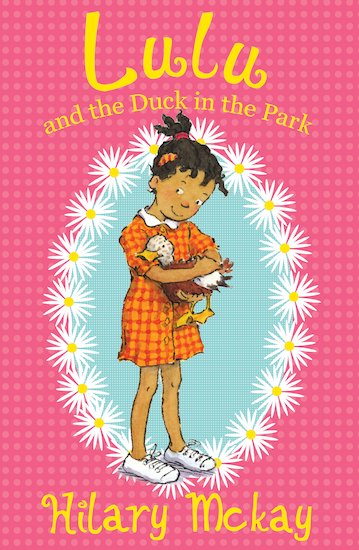
Book Review: Lulu and the Duck in the Park by Hilary McKay (2012)

Lulu has many interesting and wonderful qualities, but what she’s known for is her love of animals and her huge collection of them. One day, while her elementary school class visits the park, she gets hold of a duck egg that needs protection. Despite her teacher’s blatant dislike of animals, Lulu takes the egg back to class with her. All is well, until... the egg suddenly starts to hatch!

This chapter book is by Hilary McKay, the author of the Casson family series, the first book of which I reviewed last year. Since it’s for a younger audience, this book deviates quite a bit from the style of the series books, but it’s every bit as well-written as McKay’s books for older readers. Lulu, whose personality reminds me a lot of Ramona Quimby and Clementine, is the kind of good-hearted, bold character kids really relate to and root for. Her predicament with the duck is just the kind of thing that makes five to seven year olds laugh, but it also appeals to that common interest in rescuing animals that leads so many kids to say they want to be veterinarians.

Though I was somewhat puzzled by the class trips to the park and a bit uncomfortable with how strict and mean Lulu’s teacher seemed to be, I don’t think these are true flaws in the story. Rather, I think they demonstrate how attuned McKay is the minds of kids. Children do often see strict adults as simply cruel, and I doubt kids will notice anything unusual about a few extra field trips. In fact, reading about walking through the park is probably more fun than reading about regular classroom activities.

An obvious companion for this book would be Duck for a Day by Australian author, Meg McKinlay. I also think it would be a nice tie-in for a science project involving hatching chicks.

Sunday, June 3, 2012

Book Review: The Twenty-Four Days Before Christmas by Madeleine L'Engle (1964)

Every year, the Austins count down to Christmas with an Advent calendar and daily surprises. This year, the Christmas season is especially exciting because seven-year-old Vicky will play the angel in the Christmas pageant, and Mrs. Austin is expecting a baby (Rob) right around the holidays. There is only one problem - what if the baby comes early and Mrs. Austin has to be in the hospital for Christmas? Vicky can’t bear the thought, and wonders how it can be possibly be Christmas if the family isn’t all together.

This novella was originally published in 1964, following The Moon by Night. It doesn’t seem to have any particular significance to the series as a whole, but since I fell in love with the Austins in their first book, I liked reading through this little piece of their family history, which introduces the youngest brother, Rob, into the family. Like all the L’Engle books I’ve read so far, this one upholds the same high standard of literary quality. Though the plot itself is somewhat saccharine, the storytelling appears effortless and immerses the reader in beautiful descriptive language. It’s obvious that this book is intended to evoke all the warmth and coziness young kids associate with Christmas, and because of that, it felt a bit predictable and gimmicky at times, but I didn’t have a real problem with that. Christmas books lend themselves to sentimentality, and I think L’Engle does a nice job of presenting those hokey holiday feelings without becoming too maudlin or mushy.

I also enjoyed the way some of Vicky’s thoughts during this story echo and underscore her reflections in the first two Austin books. The first instance of this happens on page four, when she compares her looks to four-year-old Suzy’s. Even at the age of 7, Vicky is aware that she is “the ugly duckling” who is “skinny and as tall as the eight-year-olds”, with “legs...so long [she keeps] falling”, while Suzy “isn’t skinny, she’s just right.” This same awareness, that Vicky is gawky where her little sister is beautiful , has been a recurring theme in the Austin series thusfar. I also took note of the way Vicky worries about ruining Christmas for her family, as in the passage below from page 7: 

I always seem to spoil things. I look out the long kitchen window at the mountains, thinking: Please don’t let me spoil anything this year.

This feeling of Vicky’s that she is somehow other, and exists separately from the rest of her family, definitely hearkens back to the feelings she articulates in The Moon By Night when her family doesn’t take to Zachary Gray, and gives the reader a glimpse into how this feeling may have developed earlier in her childhood, as Vicky began to understand her place amongst her siblings.

The Twenty-Four Days Before Christmas is a perfect holiday read that I might just pick up again when Christmas rolls around this year. It’s also a nice slice of life story for readers anxious to know everything about the Austin family. The illustrations in the 2010 edition are somewhat distracting from the mood of the story, but even their contemporary style doesn’t rob L’Engle’s writing of its charm and nostalgia.