Friday, September 16, 2011

Book Review: Fractions = Trouble! by Claudia Mills (2011)


Fractions = Trouble! is a sequel to 7 x 9 = Trouble! Main character Wilson Williams struggles with understanding fractions, so his parents hire a tutor, Mrs. Tucker, to help him. Wilson is convinced he is the only student in the history of his elementary school who has ever needed a tutor, and he keeps the tutoring sessions secret from his best friend, Josh, and from everyone else at school. In the meantime, he and his younger brother, Kipper, make plans for the science fair. Wilson decides to study his hamster while Kipper studies the effect of wind on different sized tents. After a few unexpected turns of events, Wilson comes to accept his need for a tutor and things end on a positive note.

This short book reminded me a lot of Muggie Maggie, a chapter book by Beverly Cleary about learning to write in cursive. I recognized the same introspective and insular point of view, and the same frustration and need for secrecy in both characters.Wilson also shares some characteristics with Richard "Beast" Best from the Polk Street School series by Patricia Reilly Giff, who worries that other kids will judge his difficulties with school. Fractions = Trouble also includes one of the best younger siblings I've read in a chapter book. Kipper is a unique character, with strange quirks, including a strong attachment to two stuffed animals. I thought Wilson's interactions with him were some of the strongest moments in the book.

All in all, a great story to share with kids who struggle in math, or with any subject. Recommended to boys in grades 2 and 3 who are just starting to read chapter books on their own.

Thursday, August 18, 2011

Book Review: Blackout by John Rocco (2011)

This picture book opens with a full-page illustration of a little girl looking bored, staring out the window. This nameless little girl, who is the youngest in her family, is lonely because everyone is too busy to play with her. Her sister chats on the phone, her mother taps away on the computer, and her father is busy in the kitchen, stirring a pot on the stove. She decides to keep herself company with a video game, but just as she settles in, all the lights go out! From that moment, things change in the little girl's household. In the silence, she and her family huddle together and by the light of candles and flashlights, climb to the roof. The neighbors join in, and soon there is "A block party in the sky" and another one in the street below, where a local business gives away free ice cream, a firefighter allows children to use the fire hydrant as a sprinkler, and a couple plays and sings music.

"No one was busy at all," observes the girl. Everyone has time for her because they are disconnected from their other duties and distractions. Without technology and  electricity to keep them occupied, everyone must turn to one another for entertainment, support, comfort, and enjoyment, a habit one family may just not want to lose even after the blackout is over.

There is very little text in this book, sometimes not even a full sentence on a page. The illustration style really lends itself to comparisons with graphic novels, as it uses a mix of large and small panels, as well as different font faces, sizes, and colors to convey not just narration, but dialogue and sounds as well. The panels show the slow movement of time from moment to moment, and also zoom in and out appropriately to highlight intimate family moments as well as larger community-oriented happenings.

As with many of my favorite illustrators (Marla Frazee and Sophie Blackall, namely), Rocco's pictures give us lots to look at and discover that isn't expressly stated on the page. One of my favorite moments early on in the book occurs when we see the family's apartment building at considerable distance on one page, and then zoom in on their windows more closely on the next. Flipping back and forth between the two pages shows that the same scenes are depicted on each page, just with different levels of focus. I love that the illustrations tell most of the family's story, while the text focuses more on the universality of the blackout experience.


I love the way this story isn't just about what happens during a blackout, but about the way disconnecting technology and electricity for one evening brought a family close together. The illustrations are beautiful - they show how many colors make up the dark - blues, blacks, grays, greens - and how bright even the stars can seem when nothing else is lit up. This would be a great story to have on hand to read to kids during a power outage, and it's also a neat way to share the experience with kids who haven't yet experienced a blackout, especially city kids whose entire lives are lit by streetlamps and store signs. I think this is also a great, positive title for combating fear of the dark, and for empowering younger siblings who often feel left out or inferior. 

Make sure to check out the book, but in the meantime, enjoy this wonderful trailer, which interviews New Yorkers about the major blackout in New York City back in 2003.


Tuesday, August 16, 2011

Reading Through History: Okay For Now by Gary D. Schmidt (2011)

Doug Swieteck has recently moved to Marysville, New York, with one of his brothers (the other, Lucas, is serving in Vietnam), his mother, whom he loves, and his abusive dad. Desperate to be out of the house and dissociated from his brother's criminal behavior, Doug starts visiting the public library, where John Audubon's drawings of birds are on display, one at a time, inside a glass case. The librarian, Mr. Powell, notices that Doug has an interest in and aptitude for drawing and helps him slowly learn to draw each of the birds. Doug enjoys these drawing sessions, and also sees stories and messages in the paintings that are dictated and sometimes even changed by happenings in his own life.
Throughout these first months in Marysville, Doug also gets a job as a delivery boy, which gives him the chance to meet many different people in the community, including an eccentric author, and he learns to read, after a teacher discovers that he secretly can't. He also meets Lil, who proves to be a friend as well as a bit of a know-it-all, and he does his best to hide the jacket he received from baseball player Joe Pepitone, so that his brother or father doesn't steal it away from him.

This book contains some of the most beautiful writing I have ever had the pleasure of reading. There's some grim stuff, too, mostly having to do with Doug's father's abusive behaviors, but even those haunting passages are written to a higher standard. I think the only things that prevent this book from acheiving true greatness are the plot points near the end of the book. Doug's brother returns from Vietnam, a major illness befalls someone important to Doug, and suddenly his father seems to clean up his act in a very contrived and completely unbelievable way. I thought these moments cheapened the story quite a bit, and condescended to the readers in a way that isn't necessary in a sophisticated book like this.

Read-alikes for this story include Tales of the Madman Underground, which is all about trying to survive a world where adults continually screw up, The Catcher in the Rye, whose Holden has a tone of sarcasm just like Doug's, and The Rules of Survival by Nancy Werlin, which also focuses on escape from an abusive parent. Don't miss this book. Its brilliance far outweighs even its most glaring flaws.

Wednesday, August 3, 2011

Book Review: The Greedy Sparrow by Lucine Kasbarian, illustrated by Maria Zaikina (2011)

The Greedy Sparrow is a retelling of a folk tale from Armenia which the author, Lucine Kasbarian, learned from her father. The story begins with a sparrow who has a thorn stuck in his foot. A woman baking bread removes the thorn for him, and the bird goes on his way. Later, though, he returns, demanding the thorn, and when he learns that the woman disposed of it, he demands something else in exchange. As the story progresses, the sparrow makes more and more demands on more and more strangers, always demanding something in exchange for an item that isn't really his to begin with. In the end, his greed gets the better of him and he ends the story no better off than when he began.

I really loved this book. The story, whose moral is, essentially, "what goes around comes around" or perhaps "you reap what you sow" has a unique flair, and there aren't many other folk tales or fables that it reminded me of. I loved that the story mentioned specific locations, such as Mount Ararat, because it grounds the tale in the culture from which it came, and provides opportunities for children to learn about a new country as they read. The illustrations, which absolutely consume every inch of white space, are beautiful, and I loved seeing the Armenian style of dress represented on each page. The sheep in this book also have wonderful facial expressions, which gave them unexpected personality.

According to a note on the copyright page inside the book, the art for this book was created with wax and oil paint, and layers were literally cut away to reveal the colors underneath the wax. Knowing this gave me a new appreciation for the illustrations, where you can actually see the strokes the artist made as she worked on each page. It's just so appealing to look at, and even the smallest details, which must have been the most difficult, appear flawless.

This book is simple enough, certainly, to be shared with preschoolers, but would also work well for an elementary school unit about folk tales or Armenian culture. I really hope my library system will purchase a copy so that I can share it at story time and beyond.

Visit Lucine Kasbarian online at lucinekasbarian.com.

Sunday, July 31, 2011

Book Review: Help! I'm a Prisoner in the Library by Eth Clifford (1979)

My most vivid memory of this book actually has nothing to do with the story itself. Rather, what I remember is that my first grade teacher was reading the book to us in school, and she got upset with me when I located a copy at the public library and finished reading it on my own. I guess that was my first understanding of what a spoiler is! In any case, the last time I read this book, it was 1989 and I was six. I remembered very little, and honestly, very little came back to me as I read. That said, though, I enjoyed visiting this quirky little story about two girls who spend the night, quite accidentally, in the public library.

There is a snowstorm starting, and Jo-Beth and Mary Rose are on their way to their aunt's house, so their father can join their mother at the hospital where a new brother or sister will be born. When their dad, known as Last Minute Harry, refuses to stop for gasoline, and then runs out of gas on the road, he instructs the girls to wait in the car with the doors locked while he looks for a gas station. They obey at first, but when Jo-Beth realizes she urgently has to use the bathroom, they wander out into the snow and head for the public library. Though they don't mean to, they wind up staying past closing time, and when they try to leave, they find themselves locked in! The rest of their night is filled with spooky noises, strange shadows, and lots of unexpected turns of events.

This book is a great first introduction to suspense. Almost every chapter ends with some sort of cliffhanger, which is then resolved in the following chapter. The explanations for many of the scary things the girls encounter are disappointing, and maybe even cheesy from an adult perspective, but for early chapter book readers, they are exciting without being terrifying, which is something I would have appreciated (and presumably did appreciate, given my need to finish the book ahead of the class) as a kid.

This book also teaches the important lesson that not everything that's old is useless. The librarian in the book worries that all of her memorabilia related to children's books will be lost when the library closes, but the girls convince her to make old things new again by opening a museum devoted to children's literature.

The story didn't feel completely dated, especially since there weren't many mentions of library practices themselves. I think the biggest thing I noticed was just the lack of technology. The girls weren't able to contact their father during the snowstorm because the phones were down. These days, though cell phones might go down in a severe storm, there would have been that extra option. The internet, too, is absent, but that didn't bother me much at all. The story still felt contemporary, and the girls' reactions to things rang very true for me.

This was a nice walk down memory lane, even if I didn't have many memories to go on. I love the cover of this book (the original, on the far left at the top of this post), and I've always sort of thought of it as more cozy than creepy. The sibling dynamics in the story also amused me - I have a younger sister, and the squabbles these girls got into were similar to ones I had with my own sister growing up. I wonder if that was another appealing aspect of it for me back when I was six.

This book is still very much in print, and my library received a new copy just this year before we opened our new branch. If you haven't read it, give it a shot. It's short, strange, and, for adults, maybe somewhat predictable, but worth reading, especially if you're a fan of kids' books.

Tuesday, July 12, 2011

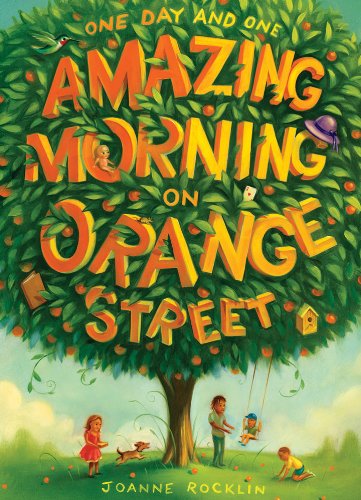
Book Review: One Day and One Amazing Morning on Orange Street by Joanne Rocklin (2011)

The focal point of this beautifully written novel is the Valencia orange tree that grows on the empty lot on Orange Street. Everyone in the neighborhood has some relationship to the tree. Ali, Bunny, and Leandra hold meetings of the Girls With Long Hair club beneath the tree. Ali's little brother, Edgar swings on the tree, with the help of his babysitter, Manny. Robert, who is not allowed to join the girls' club, conducts missions behind the vines. Long ago, it was also the place where Ms. Snoops, an elderly neighbor, played with her best friend, Gertrude. Each of these characters becomes troubled when, one morning, an orange cone appears at the edge of the lot, later accompanied by a mysterious stranger. They speculate as to what this means for the future of the tree, and the future of Orange Street itself.

It's hard to properly describe this book, because its true merits are in the artistic telling of the story. Though not much happens for most of the book, the innermost secrets, wishes, desires, fears, and hopes of these characters are expressed in beautiful language, with very carefully selected words. Robert's desire to perform magic, Bunny's constant worries over her mother's safety on plane trips, and Ali's hopes for her brother, whose brain tumor left him unable to speak, are all described in fresh, new language, with true understanding of what it's like to be caught in between childhood and adolescence. 

It is the way the story is told, not the story itself, that make it remarkable, and made me want to turn every page. I was taken back to my own summers spent out in the neighborhood, hanging out with the neighbor kids, creating clubs on various themes, and investigating my own share of suspicious changes on the street. This book captures and distills exactly what it means to be a kid, and what it means to value community, tradition, and history, even as kids grow up and move beyond childish games and ideas.

Because I really don't think I can do this book the justice it deserves, I'll let it speak for itself. Here are just a couple of passages I enjoyed:

That morning Ms. Snoops noticed the orange cone, too, she went outdoors to deadhead her marigolds. She didn't like to disturb those hard-working 9-1-1 operators unless it was serious (especially so early in the day), but she knew that ominous orange cone could only mean one thing.

"Murder!" cried Ms. Snoops. She glanced around to make sure no one had heard her, then hurried inside to make that early morning phone call.

I am so impressed by the way Rocklin depicts Ms. Snoops's failing memory. Her thought process is amusing, but it's clear the author isn't making fun of her, and that the reader is meant to have sympathy for the elderly woman who is so often confused by simple daily occurrences.

And Ruff didn't know he was keeping the orange tree healthy, when he did his business under the tree.

But Ruff knew so many other things, that morning:
He knew he was sleepy.
He knew the earth smelled of stinky fertilizer and worms.
It was warm under his nose, but cooler where his belly touched the ground.
Something tiny, maybe a ladybug, was tickling his left ear.
A small rat raced through the weeds.
Mitzi the cat was watching somewhere.
Robert, eating a PB & J sandwich behind the vine, was watching too.
Ants scurried over and under the hollowed-out orange skins.
A wasp buzzed above Ruff's head, but not close enough to sting.
A squirrel held her breath on the branch above the wasp.
Hummingbirds whirred and hovered, like tiny helicopters among the blossoms, feeding their babies again and again.
And above them all sat Bunny/Bonita, lost in her book, her wristwatch ticking.
And also Ruff was thirsty.
And he had to pee again.
And he was much too deliciously sleepy to get up.
All that, Ruff knew. 

I love the poetic style of these one-sentence paragraphs, and the way the dog's observations appeal so perfectly to all five senses.

This is such a well-written and interesting book - I really recommend it to everyone who loves kids' books, and especially to those kids - boys and girls - who seek out and appreciate realistic fiction.

Sunday, July 10, 2011

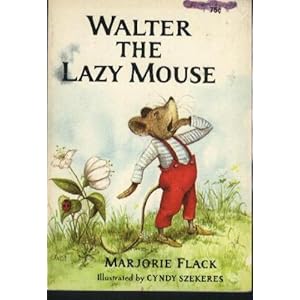
Book Review: Walter, the Lazy Mouse by Marjorie Flack (1937)

Walter is a very lazy mouse. He is always late to school, and spends so much time in bed that when his family moves away, they leave him behind.  Alone and scared, Walter heads out into the world in search of his mother, father, and siblings. After getting lost in a dark forest, he makes friends with a turtle and becomes the sole inhabitant of his own island, which he names Mouse Island after himself. He also befriends three frogs, whom he names (Lulu, Leander, and Percy), clothes, and attempts to educate. Having his own island - and friends who depend on him - means Walter can't be lazy anymore. He must find ways to clothe, feed, and shelter himself,  and when things don't go right, he is the only one around to fix them. In the end, he overcomes his laziness, and reunites with his family, who realize just how much he has changed.
I don't generally like books about talking animals, but this book quickly became an exception. The illustrations, which show realistic-looking frogs, turtles, and mice in equally realistic natural surroundings, are completely charming, and the story itself, though somewhat unusual, kept me interested from beginning to end. I especially loved the strangeness of the frog characters. They needed constant contact with Walter to be able to remember him, and in times when Walter wasn't around, they forgot everything he taught them, including their own names! Turtle was a comforting character, and certainly one I would have latched onto as a child, since the circumstances of Walter's abandonment would have troubled me quite a bit. He seemed to be the voice of reason throughout the book, and a surrogate parent for Walter in the absence of his own mom and dad.

They don't write books like this anymore, and I think that's a shame. Walter's story is the kind of adventure kids love to read about, and the way Flack imagines the personalities of different woodland animals really impressed me. Despite the obvious lesson the story wants to teach - don't be lazy - there is a lot of clever creativity at play in this book, and it makes for a truly unique and wonderful reading experience.

Marjorie Flack is also the author of one of my childhood favorites, The Story About Ping, as well as Angus and the Ducks and The Country Bunny and the Little Gold Shoes. She passed away in 1958, but her memory lives on through The Marjorie Flack Award for Fiction, an annual creative writing award at Anne Arundel Community College.