Monday, December 22, 2014

Book Review: Following Flora by Natasha Farrant (2014)

Following Flora is the second book in the Diaries of Bluebell Gadsby series, following last year's After Iris. (In the UK, the title is Flora in Love.) A year has passed and  Zoran, the family's au pair, has moved out and taken one of his guitar students, Zachary Smith, under his wing in the aftermath of Zach's grandfather's stroke. Zach instantly hits it off with Flora, the oldest Gadsby sister, who is just one of three Gadsbys involved in a romance. Blue has started dating her best friend, much to her utter confusion, and Twig has a crush on a girl in school which has completely changed his behavior. Only Jas is not in love, and she feels so left out she turns to poetry as her solace. In the meantime, the Gadsby parents struggle to accept that they are expecting a new baby.

The characters in this series are so well-realized that the plots of the books are almost irrelevant. So many things are going on in Following Flora, to the point that there isn't really one main thread to follow, but it doesn't matter because the chaos is part of the fun of reading about this quirky family. Few family stories for kids are as honest as this one about the way parents and siblings really act with one another. While this book is by no means dark and dreary, it also doesn't pretend that life is an endless parade of sunshine and lollipops. Middle school readers in particular appreciate this type of honesty, and it is perfectly handled by Natasha Farrant.

Often books like this which include transcripts of video make those sections of the book feel like gimmicky filler, but in Following Flora, as in After Iris, they are used perfectly to further the action of the various subplots. The really nice thing about having a camera's eye view of the action is that each member of the Gadsby family is able to assert his or her personality in just a few lines instead of the author spending pages and pages on describing each one. Because the family is so dramatic and chaotic, it only makes sense for them to act out their shenanigans on film, and for Blue, the quietest of the bunch, to be the one behind the lens.

Following Flora reminds me a lot of Anne Fine's The True Story of Christmas, in that it brings family dysfunction to life in a way that is realistic and humorous at the same time. (Why are British authors always so good at that?) The interactions between the siblings also echoes the way the girls talk to each other in The Penderwicks, but the adult characters are much less stereotypically good in the Gadsby books. Readers who enjoy Hilary McKay's Casson family will be enamored of the Gadsbys in the same way, and everyone who reads this book will immediately start counting down to when the next book is out.

Sunday, December 21, 2014

Book Review: The Story of Holly and Ivy by Rumer Godden, illustrated by Adrienne Adams (1958)

The Story of Holly and Ivy is a short story, which has been published in both chapter book and picture book formats. This edition is the original from 1958 and includes charming red and green line drawings by Adrienne Adams. As the author states on the very first page, the story is about wishing. Holly, a Christmas doll on sale at the toy shop wishes a girl would take her home and play with her. Ivy, an orphan who has run away, wishes to find someone with a Christmas tree and no children to be her grandmother. Mrs. Jones and her police officer husband wish for a little girl with whom to spend the Christmas holiday. Through a series of unlikely events, all three wishes manage to come true, resulting in a very Merry Christmas for all.

Though the happy ending is an obvious given from the outset, Godden makes the wait for the resolution worthwhile. Her descriptions of the toys in the toy shop (especially the creepy and cruel owl, Abracadabra), the details of Ivy's experience at the orphanage, where she is the only child not taken into a family home for the holidays, and the conversation the Joneses have about whether to decorate for Christmas all paint vivid pictures of the needs of each character. The reader, therefore, does not root for just one character, but for the Christmas miracle that will fulfill each of their desires. Some books about such Christmas miracles seem insincere or maudlin, but this one resists becoming overly melodramatic, and is instead very matter-of-fact in its telling of unlikely events. The real reason to read this book is not to find out how it ends, but to see how skillfully Godden brings the reader to the only possible conclusion.

Sunday, December 14, 2014

Book Review: The Light at Tern Rock by Julia L. Sauer (1951)

The Light at Tern Rock is a very short novel by Julia L. Sauer which received the Newbery Honor in 1952. The story follows a young man and his aunt, who are asked to look after the lighthouse at Tern Rock while the lighthouse keeper takes a few days of leave. The keeper promises he will return by December 15, but when this date comes and goes, and more and more days pass, Ronnie realizes he will miss the Christmas festivities with his schoolmates and be stranded on the rock for the holiday instead.

I appreciate this book for its economy of language, its carefully presented moral, its unapologetic religious viewpoint, and its unexpectedly emotional ending. No one writes books like this anymore. For kids ages 8 and up, this is a much better lesson in the true meaning of the Christmas season than How the Grinch Stole Christmas. The story focuses not just on giving, but on forgiving, and on preparing oneself, wherever one happens to find himself, for the coming of Christ on his birthday. The story might seem slow to some kids, even with the low word count, but it would work nicely as a family read-aloud on Christmas Eve, or a component to a CCD or Sunday school lesson. Also see my review of The Birds' Christmas Carol for more inspirational Christmas reading. 

Wednesday, December 10, 2014

Book Review: The Battle of Darcy Lane by Tara Altebrando (2014)

It seems like there is one book every year that feels like it was written just for me. For 2014, that book is The Battle of Darcy Lane. Main character Julia is looking forward to a summer of fun with her neighbor and best friend, Taylor. Taylor's plans change immediately, however, when a new girl named Alyssa moves to the neighborhood. Both Alyssa and Taylor are cruel to Julia in big and small ways, putting her down as they assert their own supposed maturity and coolness, prank calling her house, and challenging her to play a complicated ball game called Russia, at which Alyssa is an expert. Throughout the summer, Julia struggles with her conflicting desires to be accepted by the other girls and to seek revenge on them for how poorly they treat her. In the meantime, she defies her parents' rules regarding an inappropriate television show, reevaluates the worthiness of some of her other, immature friends, develops a crush on a boy in the neighborhood, and deals with the possibility that her parents might want another child.

This book does absolutely everything right. Therefore, in lieu of a review, here are several reasons to love this book:
  • Parental involvement. In this book, Julia is not left to deal with everything on her own. Rather, she has supportive, loving parents who are perceptive enough to know when something is wrong and involved enough to persist when Julia is not immediately forthcoming with the problem. Julia's mother, especially, is understanding of the situation, and empathetic at some moments to the point of tears. She represents that adult mindset that knows it will all eventually be okay, but she is not completely immune to the way the girls' cruel treatment affects her daughter. As the daughter of a woman who once volunteered to turn the garden hose on bullies marching up and down in front of my house, I was pleased to see a mom character who was present, involved, and invested. 
  • Normalized religion. I made a post on my Tumblr account months ago about #weneeddiversebooks as it relates to the treatment of religion. This book, while not at all about religion, mentions in passing a number of times that Julia has gone to Mass with her mom. It's wonderful to see a Catholic character portrayed as a normal person with normal problems, rather than as a plot device specifically focused on bigotry or acceptance. I would have loved seeing those references when I was in the target age range for this book. Being religious is a normal part of life for many kids, and it's great to see that represented in such a mainstream book.
  • Realistic cruelty. Sometimes books with "mean girls" in them go overboard with the specific ways those girls are cruel. This book does a great job with the subtlety girls use to hurt each other, and with the emotional rollercoaster Julia experiences as Taylor and Alyssa seem to change their minds about her on a daily basis. The prank calls were an especially good choice, as they represent the secret, underhanded way girls sometimes behave in these situations, and they show the caller's complete disregard for not just Julia but her family as well. 
  • Cicadas. This story is set during a summer where cicadas are expected to hatch. Kids are fascinated by the idea of cicadas, so from the standpoint of attracting readers alone, this is a strength of this book. Beyond that, though, the anticipation of the cicadas, the excitement of their arrival, and their slow dissipation give the novel a natural rise and fall that matches the rise and fall of the plot. Though the cicadas are expected from early in the book, their involvement in the story does not feel forced, and any metaphorical connections to Julia's situation are very subtle. 
  • Russia. The game of Russia provides perfect tension throughout this book. It's the kind of thing that everyone wants to be able to do when they see someone else doing it, and Julia's desire to beat Alyssa at the game builds the rivalry between those two characters. Tween friendship can be a competitive sport unto itself, and Russia just gives that sense of wanting to be the best a physical manifestation for the sake of the story. The author also provides the thirteen steps of the game at the back of the book, which is sure to encourage every girl who reads the story to at least give it a try. 
  • End of Daze. This is the television show that Taylor and Alyssa watch, and which Julia is forbidden to watch, but sees anyway with a neighbor boy. Every kid has a story about sneak-watching a show against their parents' wishes, and even though the show was invented for this story, the plot lines Julia describes are very realistic and reminiscent of shows real kids are not likely to be allowed to watch if their parents are particularly protective regarding media consumption. 
  • Cell phones. Julia, at age twelve, does not have a cell phone! So many middle grade novels assume that all kids have them, and need them, and this book sends the opposite message. Julia's lack of a phone also serves as yet another barrier which separates her from coolness in Alyssa's eyes, and the fact that Julia's mother doesn't just go out and buy her one to help her fit in sends a wonderful message to readers who might be a lot like Julia. 
The book that helped me through my own traumatic friendship experiences in the 1990s was Just As Long As We're Together by Judy Blume, which I read and read  until the cover nearly fell off. The Battle of Darcy Lane is that book for the 2010s. Girls will see themselves, their lives, and their feelings in this book and they will relish the knowledge that though they may feel isolated, they are by no means alone. I also loved Roomies, which is co-authored by Tara Altebrando, so now I'm really looking forward to her future books!


Sunday, December 7, 2014

Book Review: Debutante Hill by Lois Duncan (1957)

Debutante Hill was the first book to be reissued by Lizzie Skurnick Books. Though Lois Duncan is best known to people of my generation and younger as a writer of teen thrillers, this book does not fall into that genre. Published in 1957, it is the story of high school senior Lynn Chambers who is at the center of the popular crowd of kids who live on the Hill. When it is announced that the mother of one of the less-popular girls has decided to organize a debutante program in order to help her daughter improve her social life, it is just assumed that Lynn will participate along with her friends. To her great surprise, though, her father, Dr. Chambers, does not approve of his daughter making her debut. Suddenly, Lynn finds herself left out of everything. While at first it seems like a major disappointment, over time, Lynn's exclusion from the debutante events leads her to make a series of important discoveries about herself, her boyfriend, her friends, and some of her classmates who don't live on the Hill.

I really love this book. I like its old-fashioned sensibility, which reminds me of Beverly Cleary's First Love books and the later books in the Betsy-Tacy series. I like that it takes a superficial experience - girls wearing gowns and attending parties in order to mark their entry in society - and turns it into a commentary on class distinctions, stereotypes, and popularity. The main character is not perfect, but she is open to change and willing to compromise, which makes her a worthy and believable role model. Even the romance storylines are handled with a heavy dose of realism - Lynn briefly dates a "bad boy" but the story resists the "good girl reforms bad boy" trope, and ultimately, Lynn is able to resolve her issues with her boyfriend in a calm and rational way, without the hysterics or drama so common in more contemporary YA novels.

High school students would probably find the writing and plot of this book too simplistic, but for grades 6 to 8, it might be just right. It's also a must-read for adults who grew up reading books by Lois Duncan - there's nothing more interesting than looking back on the early works of a favorite author. As a bonus, also read Publisher's Weekly's Q & A with Lois Duncan.

Friday, December 5, 2014

Book Review: Little Green Peas by Keith Baker (2014)

In this picture book, scenes populated by dozens of little green peas teach young readers about colors. Keith Baker's pictures are fabulously detailed, and kids could spend hours poring over each page and studying the activities of the busy little green peas. There is just so much to see, including a little green pea version of Rapunzel, peas taking ants and caterpillars for walks on leashes, and baby green peas sliding out of their pods into the arms of waiting parents. The book is formatted so that a given color appears on one two-page spread, featuring a few objects of that color as well as the word itself in big block letters. Then the reader turns the page to see the little green peas interacting in some way with the objects just introduced. 

This is definitely the most engaging of the peas books, which also include LMNO Peas and 123 Peas. My own daughter is just one, and she can't get enough of pointing at every pea on each page to ask me who it is and what it is doing. This is also one of those rare concept books that actually teaches the concept, but without becoming too boring and instructive.

Monday, December 1, 2014

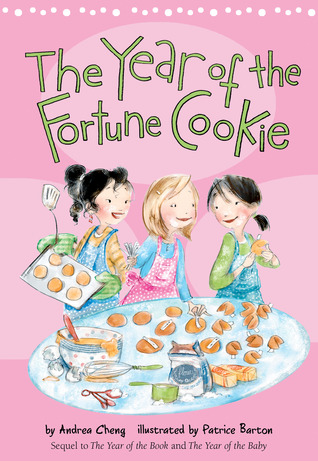
Book Review: The Year of the Fortune Cookie by Andrea Cheng (2014)

As she did in the The Year of the Book and The Year of the Baby, Andrea Cheng writes beautifully in The Year of the Fortune Cookie about Anna’s family life and friendships, as well as her experiences in school and her internal struggles and emotions. Refreshingly, even though Anna is now in middle school, the author does not introduce a sudden onslaught of superficial dramas. Instead, Anna expands her circle of friends to include other like-minded kids, takes on a service project to benefit the orphanage where her baby sister lived, and calmly and maturely works to convince a strict teacher that she deserves the opportunity to miss several weeks of school to make her trip.

As in the previous books, parts of the story are spent reflecting on Anna’s cultural identity as compared with that of her American classmates, but the focus is less on a feeling of ostracization and more on a feeling of comfort in learning about her Chinese roots. In fact, this book is an overall comfort to girls entering middle school, as it provides a saner and less scary alternative to the picture of the middle school experience often provided by books at this level.