Wednesday, May 15, 2013

Book Review: I'm with Stupid by Geoff Herbach (2013)


I’m with Stupid is the conclusion to Geoff Herbach’s trilogy about nerd-turned-jock Felton Reinstein. (The first two books were Stupid Fast and Nothing Special.) In this last book, Felton is now a high school senior and a major football star. He’s being recruited by a number of schools, and ESPN will broadcast his college decision on television. Aleah, Felton’s girlfriend, is being uncharacteristically distant, while Andrew and Grandpa Stan fret about Felton’s well-being from their home in sunny Florida. As his senior year wears on, Felton must deal with his mother’s latest disgusting affair, his troubled freshman mentee, who desperately needs someone bigger and stronger to protect him, and his continued discovery of similarities between himself and his father, who committed suicide. Felton has learned to deal with being stupid fast, now he just has to learn how not to be stupid.

I have loved Felton’s voice from the beginning of the first book, and I was pleased to return to it one last time for this enjoyable final installment in his life story. Felton is troubled, but completely lovable as well, and the reader can both sympathize with his pain and wish the best for him, and also completely understand why he sometimes wants to be self-destructive. Dark themes figure heavily in this book. There is a lot of drinking, lots of discussion of death, a couple of abusive parents - and yet, the book itself is not a “dark YA novel.” Rather, it is a novel about overcoming the dark things in life to make room for the light. Felton is haunted by his dad’s death, but he also has a lot of people to love and support him if only he will let them in. This is not a book glorifying death and destruction. Rather, it’s a story about how one teenage boy who has been failed by adults and wounded by circumstances beyond his control gets his act together in time to join the real, adult world.

This book strikes a nice balance between the non-stop humor of the first book and the almost overly-emotional lovefest that makes up a lot of the second book. Felton’s journey has been anything but easy, and I appreciate that Herbach didn’t give him a neat and tidy resolution early on. Though each book is a story of its own, it is the series as a whole that gives a complete portrait of Felton’s transformation, not just physically, but on the inside, too. I’m with Stupid is the kind of book that will appeal to fans of sports-themed fiction by authors like Rich Wallace, Mike Lupica, and Chris Crutcher, but it also has the literary appeal of books by John Green, David Levithan, or Robert Lipsyte. This makes it a book that can appeal to a wide audience, and I think teens who choose to read it will find themselves pleasantly surprised by the depth of the story, as well as its entertainment value.

I’m with Stupid is best for high school readers who have read the other books in the series. I think readers could enjoy this book without reading the first two, but it wouldn’t have the same impact without all of the backstory of the first two books. For another great story about troubled teens overcoming the adversity of their lives, also try John Barnes’s 2010 Printz Honor book, Tales of the Madman Underground.

Sunday, May 12, 2013

Book Review: A House Like a Lotus by Madeleine L'Engle (1984)

Polyhymnia “Polly” O’Keefe has been given an unexpected opportunity. Maximiliana “Max” Horne, an older woman who lives near Polly’s home on Benne Seed Island, has taken a special interest in mentoring her. As part of this mentorship, Max has arranged for Polly to visit Greece, and to work as a go-fer at an international literary conference on Cyprus. While in Athens, Polly becomes acquainted with Zachary Grey, who is as charming and as undesirable as ever, and she does her best to work through her feelings about the terrible way Max betrayed her before she left home.

Throughout the time I have been reading each of L’Engle’s Austin/Murry/O’Keefe books, I have favored Vicky over Polly. Though both girls are portrayed as somehow special, Vicky has always seemed more believable and relatable, while Polly has always struck me as too perfect and too unrealistically good. This story is the first one where Polly has actually seemed like a human being. I was pleased by this for the sake of this particular story, because I enjoyed spending time with a main character who had some layers and some emotional depth. When considering the continuity of the overall series, however, the Polly of A House Like a Lotus is not the same Polly of the earlier books. Polly actually reminds me a lot of Vicky in this book - which is fine with me, because I like Vicky, but somewhat odd when one views the entire series as a unit. I read one interesting blog post where Mari Ness of Tor.com speculates that L’Engle may have actually set out to tell this story about Vicky, not Polly, and then changed her mind when she realized it would be difficult to cause pain to a character she identifies with so closely. That argument makes a ton of sense to me, and as Ness points out, it would explain why we’re forced to put up with Zachary Grey again.

Ness’s post and many others that I read also share another common interpretation of this book that I have to admit I totally missed. We are told in the book that Max is a lesbian, a fact which causes varied reactions from Polly, her parents, her siblings and the kids at Polly’s school. At the critical moment where Polly feels so horribly betrayed by Max, it seems that everyone - Wikipedia, Goodreads reviewers, and authors of scholarly articles - believes Max has made a sexual pass at Polly. I did sort of expect something like that to happen, based on how upset Polly was and how long it took her in the narration to get around to describing the night of her betrayal, but I have read the passage where it happens at least ten times, and I still don’t see definite textual evidence that Max did anything to Polly other than drink too much and scare her. It makes sense to assume that more happened, but had I not read anything about this book before posting this review, I never would have realized that Max made any sort of overture toward Polly.

Despite its weirdness, though, I really loved this book. I enjoyed catching up with the O’Keefes, and learning of the latest additions to their family. I thought Polly’s relationship with Renny was sweet, though a bit strange given their age difference. The flashbacks to the growth of Polly’s friendship with Max were very effective, and I enjoyed moving back and forth in time as Polly reflects on what has happened and does her best to forgive. I also appreciated the obviously Christian message about forgiveness. Polly desperately wants to forgive Max, but she must first work very realistically through her layers of grief. I appreciated that there is never any doubt as to whether Max should be forgiven, but that it is still difficult for Polly to get in touch with her again. I also thought the second part of the book, where Polly attends the conference was a bit touchy-feely, but also moving in its own way. Most of the characters didn’t seem realistic, but there was still something interesting about the way these people from so many different places became like a family to Polly and to each other.

A House Like a Lotus has its problems and its critics, but I would place it in my top five of the L’Engle books I have read so far, and I would say it is my favorite of the O’Keefe series. I am actually looking forward to seeing Polly again in An Acceptable Time, and I’m eager to finish this reading exercise, hopefully by the end of this summer. Only three titles left - Many Waters, An Acceptable Time, and Troubling a Star.

Sunday, May 5, 2013

Book Review: Lotta on Troublemaker Street by Astrid Lindgren (1962)

Lotta is five years old, and she lives on Troublemaker Street with her parents, older siblings,  Maria and Jonas, and her stuffed pig, Bamsie. One morning, after dreaming that her siblings hit Bamsie, she wakes up in a terrible mood, believing that the events in her dream actually happened. After that, though she would rather go naked than wear it, her mother tries to dress her in an itchy sweater. Fed up, she destroys the sweater then runs away to Mrs. Berg's house next door. Mrs. Berg helps her set up shop in the attic, and Lotta plans to stay forever... until she realizes how dark it gets at night.

I never cared for Pippi Longstocking as a kid, but I do wish I had known about Lotta! Like Ramona, Clementine, and Junie B., Lotta is a spirited little girl with a lot of personality, just trying to make sense of growing up. Like Alexander in Judith Viorst's famed picture book, Lotta is having a bad day, and all she wants to do is escape. Kids and adults of all ages can relate to this universal experience, and kids, especially, will be thrilled to live vicariously through Lotta's new life in the attic next door. I think they will also love Mrs. Berg, who acts as a grandmotherly figure in Lotta's life, and whose approach to Lotta's anger at her parents is reminiscent of Mrs. Piggle Wiggle.

This is a chapter book, but a very short one, and many of Lotta's other stories - at least the ones at my library - are longer picture books instead. The edition I read for this review actually came out in 2001, with illustrations by Robin Preiss Glasser, who draws Fancy Nancy. Any Fancy Nancy fan who sees the cover of this book will be instantly drawn to it, if only to make sure it isn't about Fancy Nancy! Lotta on Troublemaker Street is also a great choice for preschoolers whose parents read them chapter books at bedtime. The story perfectly embodies the mind of a real five-year-old, and kids will enjoy the comfort that comes from seeing an end to Lotta's terrible day.

This book is charming and funny, and thankfully, still in print! Try it out with a parent/child book club for kindergarten or first graders, or as a bedtime read-aloud with your own five-year-old on his or her worst day.  For other old school read-alikes, try Two of a Kind by Beverly Cleary, Nora and Mrs. Mind-Your Own-Business by Johanna Hurwitz, or Betsy's Little Star by Carolyn Haywood.

Sunday, April 28, 2013

Book Review: Eddie and Gardenia by Carolyn Haywood (1951)

Eddie loves his goat, Gardenia, but when she chews the roof off of Father's new car, there's no way she can keep living with the family in their suburban neighborhood. Eddie writes to his uncle Ed to ask him to take Gardenia to live on his Texas ranch. Uncle Ed happily agrees- and he invites Eddie to the ranch for a few weeks to learn how to be a cowboy.  In Texas, Eddie receives lessons from his aunt, pals around with his cousin, learns some Spanish from a Mexican ranch hand, and even proves himself to be a true cowboy worthy of his very own spurs.

I have always loved Carolyn Haywood, but the characters I knew best as a child were Betsy and her sister, Star. In my continuing efforts to explore more books published in the 1950s, I decided to give this one a try, and I was pleasantly surprised by how much I enjoyed Eddie and his ranch adventure. Eddie is an upbeat, well-behaved character, whose heart is always in the right place, and whose attitude is one of hopeful excitement. He is just daring enough to capture the attention of small boys who long for adventure, but he is never mischievous or disrespectful, which is something many parents who visit my library specifically look for in children's book protagonists. His adventures are exciting, especially to kids who have never visited a ranch, but they are also totally plausible. Nothing happens to Eddie that couldn't conceivably happen to any child in his same situation.

Carolyn Haywood's writing style also does not disappoint. The details she uses to describe Eddie's train trip to Texas, the ranch itself, and Eddie's experiences driving, feeding "dogies" and riding ponies are extremely vivid. Even without the book in front of me, I can envision much of what happened to Eddie, almost as though I were there.

Kids who love gentle realistic stories with adventures that are exciting but stick close to home, will adore Eddie. This book is reminiscent of other contemporary chapter books with male protagonists, including the Martin Bridge, Alvin Ho, and  Justin Case series. Eddie also reminds me quite a bit of Beverly Cleary's Henry Huggins, and Johanna Hurwitz's Russell.  Eddie and Gardenia is the third of sixteen titles about Eddie. The others include Little Eddie, Eddie and the Fire Engine, Eddie's Menagerie, and Eddie's Friend Boodles. 

Sunday, April 21, 2013

Book Review: McBroom Tells the Truth by Sid Fleischman (1966)

In the tradition of American tall tales comes the story of Josh McBroom, his wife, Melissa, and their family of eleven red-headed children. Swindled by Hector "Heck" Jones, McBroom hands over his last ten dollars in exchange for a marshy pond eight acres deep. He figures he's completely doomed, but his luck changes when the pond suddenly dries up  and everything he plants on the farm grows at record speed. Heck Jones would do anything to go back on the deal he made with McBroom, but the McBroom family is too smart for that!

This story is a fun tale of good triumphing over evil against all odds. Kids as young as four can appreciate the silliness of McBroom's good fortune, and they will love cheering him on against mischievous Heck. The repetition of the kids' names as one continuous word - "Willjillhesterchesterpeterpollytimtommarylarryandlittleclarinda - is a fun aspect of  the story and one that would make it an instant read-aloud hit with any group of early elementary schoolers. I also like that each of the kids has a signature move that he or she does each time the family gets excited about something. Nose twitching, arm flapping, and teeth whistling are great actions that kids listening to the story could even try to imitate. 

Kids love to be silly, and they love to feel like they are in on a great joke. This book understands that natural inclination and plays with it, giving kids a great story that will inevitably give them the giggles. Recommend McBroom to  readers who have loved stories about Pecos Bill and Library Lil, and to readers with wild imaginations who enjoyed The Stories Julian Tells and love to spin yarns of their own. Other McBroom stories are also available, including McBroom and the Big Wind, McBroom's Ear, and McBroom's Ghost.

Sunday, April 14, 2013

Book Review: Gone-Away Lake by Elizabeth Enright (1957)

Portia is excited to spend the summer with her cousin, Julian, but she never expects that they will discover an abandoned lakeside community, or that they will make friends with a pair of elderly siblings who still inhabit two of the rundown houses. At Gone-Away Lake, as their friends Aunt Minnehaha and Uncle Pindar call it, Portia and Julian discover life as it was 50 years ago, while having their own summer of modern-day adventures they will never forget.

In this book, as in The Saturdays, Elizabeth Enright celebrates childhood independence. Whereas the Melendy kids explore New York City unsupervised, with just their allowance to pay their way, Portia and Julian are given free rein in the country, where they can enjoy the secret of a forgotten village, and make new friends without sharing them with their parents or with Portia's little brother, Foster. Especially interesting about this story are the connections Portia and Julian feel to Minnehaha and Pindar as children. They never tire of hearing about their friends' fights, friendships, and adventures, and they engage with those stories so fully that they are inspired to create a club of their own in the hopes of recapturing some of that fun and excitement.

Some things about this book bothered me. I couldn't quite buy into the notion that an entire group of fairly wealthy families would abandon not just their homes, but all the contents of those homes, and never return for them. I thought this might be explained at some point, but it never was, and I was distracted by the feeling that there should have been some big reveal of the "truth" about Gone-Away. I also couldn't help but feel that Minnehaha and Pindar  were living like Miss Havisham - waiting for the return of a day that would never be again. Perhaps this was intentional, as I think Portia and Julian breathe some fresh air into the lives of the two older people. Still, I wanted the characters in the story to feel disturbed as I did, and instead they were almost too accepting of the whole strange scenario.

That said, this is a well-written book full of interesting situations, well-described characters and settings, and everything a child wants in a summer story. I am not surprised that it was a Newbery Honor book in 1958, and I think, of the Newberys I've read, it's one of the older ones that still holds up well enough for contemporary audiences. It is similar in some ways to Miracles on Maple Hill - both books are even illustrated by the same artists, Joe and Beth Krush - and I think it also compares well to the Swallows and Amazons books, A Lemon and a Star, and The Railway Children. There is also a sequel, Return to Gone-Away, published in 1961.

Sunday, April 7, 2013

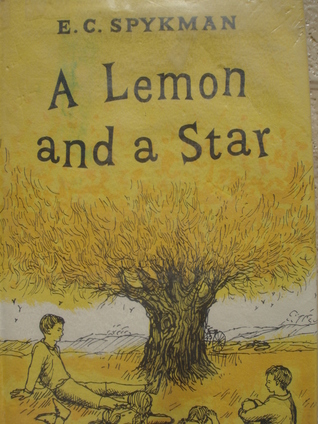
Reading Through History: A Lemon and a Star by E.C. Spykman (1955)

A few weeks ago, after reading Miracles on Maple Hill, I realized that while I enjoy children's novels from the 1950s, I have read very few. This inspired a visit to my local library with the specific goal of choosing some Old School Sunday reading material published in the 50s. A Lemon and a Star was a particularly exciting discovery both because I had never heard of it before, and because it ended up being such a great story.

A Lemon and a Star is about the four Cares children - Theodore (Ted), Hubert, Jane, and Edith (Edie), who live with their widower father and his household staff in Summerton, Massachusetts in the early 1900s. Because they have no mother, and because they are each mischievous little people, the Cares kids run rampant around the countryside, getting into fights, falling into the reservoir, capturing foxes, wallowing in mud and even occasionally sneaking into the city by train. Much of their time is spent bribing each other into keeping information from their dad, and in trying to keep Edie happy so she doesn't spoil all their plans before they even get off the ground. They have their own codes of loyalty and friendship, and their own ideas about how the world works, and they employ these rules as they look after themselves and each other.

Like Swallows and Amazons and The Boxcar Children, this book is appealing because it shows kids on their own doing things for themselves. The Cares children are not as responsible as John and Susan Walker, or as Henry and Jessie Alden, but that just adds to the fun of the reading experience. Most kids - whether they grow up in the early 1900s, the mid 1950s, or the early 2010s - will never have the freedom given to the Cares kids, and it's a lot of fun to live vicariously through them as their adventures unfold. I also think kids like to be shocked by the bad behavior of other kids, even if it the behaviors are not something they would do themselves. My husband and I read this book within a few days of each other, and as we discussed it, we just kept laughing and saying, "They're so bad!" Our enjoyment of their behavior reminded me a lot of reading The Best Christmas Pageant Ever. Nobody wants to act like the Herdmans, but everyone wants to know what they'll do next. The same is true for Ted, Hubert, Jane, and Edie.

For a book about so much mischief, the writing is very beautiful. Images of the red house where the family lives, the reservoirs full of sparkling water, and Ted's black eye after a fight are just a few of the moments in this book that bring it fully to life and make it so easy to imagine really being in Summerton watching these kids playing. The personalities of the four kids come across very well. Ted is portrayed as the frustrated oldest child who is stubborn and annoyed by his younger siblings. Edie is the spoiled baby of the family who can be bought but not controlled. Hubert and Jane fall somewhere in the middle, trying to do the right thing and keep their father happy, but also endlessly fascinated by thir older brother and filled with concern for him when he is in danger. Every child reader can find a character to sympathize with in every scene.

Like many books for kids published in the 1950s, A Lemon and a Star is a great celebration of the adventures kids can have in their own backyards. It makes a nice read-alike for The Moffats, The Railway Children, and Swallows and Amazons, as well as for books by Carolyn Haywood and Beverly Cleary. Though I think they will be somewhat hard to find, I hope to track down and read the other three books in this series: The Wild Angel, Terrible, Horrible Edie and Edie on the Warpath, all of which sound wonderful.