Sunday, April 14, 2013

Book Review: Gone-Away Lake by Elizabeth Enright (1957)

Portia is excited to spend the summer with her cousin, Julian, but she never expects that they will discover an abandoned lakeside community, or that they will make friends with a pair of elderly siblings who still inhabit two of the rundown houses. At Gone-Away Lake, as their friends Aunt Minnehaha and Uncle Pindar call it, Portia and Julian discover life as it was 50 years ago, while having their own summer of modern-day adventures they will never forget.

In this book, as in The Saturdays, Elizabeth Enright celebrates childhood independence. Whereas the Melendy kids explore New York City unsupervised, with just their allowance to pay their way, Portia and Julian are given free rein in the country, where they can enjoy the secret of a forgotten village, and make new friends without sharing them with their parents or with Portia's little brother, Foster. Especially interesting about this story are the connections Portia and Julian feel to Minnehaha and Pindar as children. They never tire of hearing about their friends' fights, friendships, and adventures, and they engage with those stories so fully that they are inspired to create a club of their own in the hopes of recapturing some of that fun and excitement.

Some things about this book bothered me. I couldn't quite buy into the notion that an entire group of fairly wealthy families would abandon not just their homes, but all the contents of those homes, and never return for them. I thought this might be explained at some point, but it never was, and I was distracted by the feeling that there should have been some big reveal of the "truth" about Gone-Away. I also couldn't help but feel that Minnehaha and Pindar  were living like Miss Havisham - waiting for the return of a day that would never be again. Perhaps this was intentional, as I think Portia and Julian breathe some fresh air into the lives of the two older people. Still, I wanted the characters in the story to feel disturbed as I did, and instead they were almost too accepting of the whole strange scenario.

That said, this is a well-written book full of interesting situations, well-described characters and settings, and everything a child wants in a summer story. I am not surprised that it was a Newbery Honor book in 1958, and I think, of the Newberys I've read, it's one of the older ones that still holds up well enough for contemporary audiences. It is similar in some ways to Miracles on Maple Hill - both books are even illustrated by the same artists, Joe and Beth Krush - and I think it also compares well to the Swallows and Amazons books, A Lemon and a Star, and The Railway Children. There is also a sequel, Return to Gone-Away, published in 1961.

Sunday, April 7, 2013

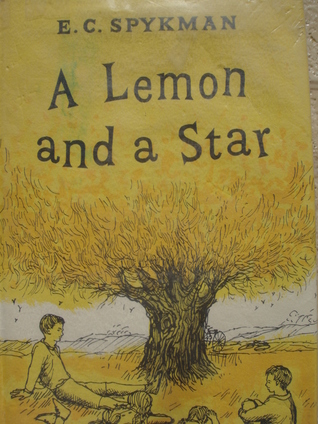
Reading Through History: A Lemon and a Star by E.C. Spykman (1955)

A few weeks ago, after reading Miracles on Maple Hill, I realized that while I enjoy children's novels from the 1950s, I have read very few. This inspired a visit to my local library with the specific goal of choosing some Old School Sunday reading material published in the 50s. A Lemon and a Star was a particularly exciting discovery both because I had never heard of it before, and because it ended up being such a great story.

A Lemon and a Star is about the four Cares children - Theodore (Ted), Hubert, Jane, and Edith (Edie), who live with their widower father and his household staff in Summerton, Massachusetts in the early 1900s. Because they have no mother, and because they are each mischievous little people, the Cares kids run rampant around the countryside, getting into fights, falling into the reservoir, capturing foxes, wallowing in mud and even occasionally sneaking into the city by train. Much of their time is spent bribing each other into keeping information from their dad, and in trying to keep Edie happy so she doesn't spoil all their plans before they even get off the ground. They have their own codes of loyalty and friendship, and their own ideas about how the world works, and they employ these rules as they look after themselves and each other.

Like Swallows and Amazons and The Boxcar Children, this book is appealing because it shows kids on their own doing things for themselves. The Cares children are not as responsible as John and Susan Walker, or as Henry and Jessie Alden, but that just adds to the fun of the reading experience. Most kids - whether they grow up in the early 1900s, the mid 1950s, or the early 2010s - will never have the freedom given to the Cares kids, and it's a lot of fun to live vicariously through them as their adventures unfold. I also think kids like to be shocked by the bad behavior of other kids, even if it the behaviors are not something they would do themselves. My husband and I read this book within a few days of each other, and as we discussed it, we just kept laughing and saying, "They're so bad!" Our enjoyment of their behavior reminded me a lot of reading The Best Christmas Pageant Ever. Nobody wants to act like the Herdmans, but everyone wants to know what they'll do next. The same is true for Ted, Hubert, Jane, and Edie.

For a book about so much mischief, the writing is very beautiful. Images of the red house where the family lives, the reservoirs full of sparkling water, and Ted's black eye after a fight are just a few of the moments in this book that bring it fully to life and make it so easy to imagine really being in Summerton watching these kids playing. The personalities of the four kids come across very well. Ted is portrayed as the frustrated oldest child who is stubborn and annoyed by his younger siblings. Edie is the spoiled baby of the family who can be bought but not controlled. Hubert and Jane fall somewhere in the middle, trying to do the right thing and keep their father happy, but also endlessly fascinated by thir older brother and filled with concern for him when he is in danger. Every child reader can find a character to sympathize with in every scene.

Like many books for kids published in the 1950s, A Lemon and a Star is a great celebration of the adventures kids can have in their own backyards. It makes a nice read-alike for The Moffats, The Railway Children, and Swallows and Amazons, as well as for books by Carolyn Haywood and Beverly Cleary. Though I think they will be somewhat hard to find, I hope to track down and read the other three books in this series: The Wild Angel, Terrible, Horrible Edie and Edie on the Warpath, all of which sound wonderful.

Sunday, March 31, 2013

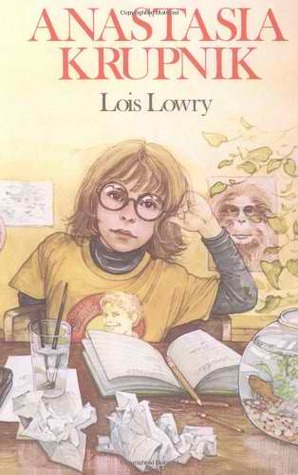
Book Review: Anastasia Krupnik by Lois Lowry (1979)

Anastasia Krupnik keeps an ever-changing list of things she likes and hates. Sometimes she hates her grandmother for losing her memory and not knowing who she is. Other times, she loves the opportunity to sit down and get to know her better. Sometimes she loves Washburn Cummings, an older boy in her neighborhood, and other times, he makes her so unhappy she adds him to the hate list. Her teacher, her parents, and even her soon-to-be-born baby brother all jump back and forth between the lists as Anastasia navigates life as a ten-year-old.

I remember the Anastasia books from childhood, but I couldn't swear that I've ever read one. As a kid, I tended to be turned  off by older books, and I think this series has always had an unfortunate set of covers that make the stories seem even older than they actually are. Reading it now, as an adult, this book was a surprise. I was surprised by the fresh writing and the main character's strong voice, and I was surprised by how quickly  the story moves, and how easy it was to get lost in it. There isn't much of a plot, really, but what makes the book stand out are all the great details Lowry uses to paint the Krupniks as real people. I loved learning about Anastasia's father, Myron, through the dedication pages in each of the poetry books he has written. I loved Anastasia's brief flirtation with the idea of becoming Catholic, and her impression of what that would mean. Anastasia's family life reminds me of many other families from middle grade series, including the Clementine,  Ramona Quimby, and Alice McKinley books. Somehow I've never thought of the Anastasia books as being in the same class with these "classics" - but I should have guessed that Lowry would write just as well in the realistic fiction genre  as she does in science fiction. 

Anastasia Krupnik will appeal to fans of the books I just mentioned, as well as to readers who like Johanna Hurwitz, Ann M. Martin, and Megan McDonald. It's tricky for me to promote books to kids when their covers look so old and strange, but it's worth giving them a great book talk - or even reading one aloud to a group in order to get kids excited about reading them once again. Very little stands between Anastasia and 21st century girls, and I'm not even sure anyone could tell just from the text that this book is older than I am! If you missed these in childhood, as I did, give them a try now - you won't be disappointed.

Sunday, March 24, 2013

Book Review: The Big Six by Arthur Ransome (1940)

In the eight books of the Swallows and Amazons series published prior to The Big Six, Arthur Ransome’s wonderful characters have imagined themselves in a whole host of situations. Sometimes they are sailors; at other times, they’re miners, at still other times, they’re explorers. This time around, the Death and Glories (Joe, Bill, and Pete) and Tom Dudgeon as well as Dick and Dorothea, fancy themselves detectives, and they’re not too far off from becoming the real thing. Someone has been casting off boats, and almost everyone believes it is the Death and Glories. They have been in the vicinity of each boat set adrift, and Mr. Tedder, the local policeman is sure he will be able to prove it was them and disband the Coot Club. Dorothea, with her wild imagination, and Dick, with his new interest in photography team up to help their friends prove their innocence and catch the real culprit.

While I will always love the Swallows the most of all of Ransome’s characters, I really grew to love the Death and Glories in this book. In their first appearance, back in Coot Club, the three boys seemed very much like one entity, with very few obvious details to differentiate one from another. In this book, the three boys’ individual personalities are much more pronounced, and I enjoyed seeing the ways they related to one another. I also enjoyed seeing Dick and Dorothea in leadership roles in this story. In all the previous books they have been in, it seems like they have always taken their cues from someone else - namely Nancy, Tom, or Mrs. Barrable. To see them as heroes in this book was a nice change of pace. I also thought it was neat to introduce a mystery element into a sailing story, and I didn’t miss the technical sailing jargon that seems to permeate most of Ransome’s other writing.

I am now just three books away from completing this series, and The Big Six is definitely among my favorites of all the books. At some points, the repetition of the evidence and the lack of action is a bit tedious, but for the most part, the fresh dialogue keeps things moving, and the slow revelations about the different clues help to build suspense so that the reader doesn’t know the outcome of the mystery until the absolute last second. Though the reader can easily guess early on who the true criminal is, it is still entertaining to see the kids solve the mystery and prove their case even when none of the adults around them could manage. Just like all the other Swallows and Amazons books, this one celebrates what kids can do on their own and proves that they should be taken just as seriously as adults.

Sunday, March 17, 2013

Reading Through History: The All-of-a-Kind Family by Sydney Taylor (1951)

Mama has five girls: Ella, Henny, Sarah, Charlotte, and Gertie, and because there are no boys, they call themselves an “all-of-a-kind family.” The family doesn’t have very much money, but they still have lots to be happy about. The girls visit the library regularly, where they are always glad to see their friend, the library lady. They have a wonderful relationship with their father’s best friend, Charlie, who gives them treats when they are sick and often comes around for dinner on holidays. They even get a little bit of money now and then to spend on secret candy to eat in bed, and to buy gifts for their father’s birthday. Throughout the year, the girls keep busy and make the best of what they do have - wonderful friends, and each other.

This first book in the All-of-a-Kind-Family series was written in the 1950s, but it takes place during the year 1912. Despite the age of the story and the fact that it is historical fiction, it is a fresh and accessible book, even today. Though the girls in the story are poor and living on the Lower East Side of Manhattan, they have many experiences that can be universally appreciated by children from all backgrounds, living in urban and rural environments. Each chapter consists of a particularly memorable episode in the family’s life, including things like the loss of a library book, the discovery of old books in their father’s warehouse, and missing out on the Passover seder because of scarlet fever. Readers learn not only what life was like for immigrants living in early 20th century New York, but also all about Jewish tradition and celebrations throughout the year. Though the girls in the story lived 100 years ago, they have many qualities, interests, and worries that contemporary kids undoubtedly share.

The All-of-a-Kind Family is a great fictional representation of growing up in a Jewish family, as well as a sweet celebration of sisterhood. There are some surprise twists at the end of the book that bring together details and characters from earlier chapters, and I didn’t see any of those coming, so I was very pleased by that. I also like how quickly the story moves, and the upbeat tone that provides a sense of hope in difficult circumstances without becoming overly sentimental about city living or poverty. Readers who are anxiously awaiting another installment in the Penderwicks series might enjoy reading about the All-of-a-Kind Family - a series with six books in all - while they wait. It might also appeal to fans of Megan McDonald’s Sisters Club books, and to readers who enjoy The Boxcar Children, The Bobbsey Twins, and Betsy-Tacy.

Sunday, March 10, 2013

Book Review: The Railway Children by E. Nesbit (1906)

Roberta (Bobbie), Peter, and Phyllis (Phil) have never been poor before, but when their father must go away unexpectedly, they and their mother move to a more modest home in the country. There isn’t much to do in their new, smaller house, and their mother is always busy writing stories to make ends meet, so the children often find themselves visiting the railway station. There they have many adventures: making friends with Perks the porter, waving to a particular old gentleman who rides the train past their station every day, and even saving a train from a very bad accident! All the while the three children are kept in the dark about where their father really is. When Bobbie finds out by mistake, she uses her railway connections to sort things out and, hopefully, bring her father home.

My husband has been nagging me to read this book for months, and I kept putting it off because I was one hundred percent sure it was an old, sad orphan story. I was completely wrong about this, as it turns out. There is some sadness in the book, but the kids are not orphans, and though the story is now over 100 years old, it reads more like a 1950s children’s novel, such as those written by Eleanor Estes and Elizabeth Enright. It is certainly somewhat old-fashioned compared to contemporary middle grade novels - the children dress in early 1900s garb, they watch a “paper chase” in one chapter, and they lack the modern sources of news and communication that would have made it much easier for them to learn of their father’s whereabouts during his long absence. The narrator also sometimes addresses the reader directly, which is not very common in contemporary kids’ books (unless they’re written by Lemony Snicket.) Even so, the dialogue between the characters sounds very contemporary, and many of the children’s arguments and conversations could easily happen in any group of 21st century children I have met.

The story itself is well-written without being difficult to read. The characters come vividly to life mostly in the way they speak, and each chapter’s adventure moves swiftly by. It is extremely unlikely that any group of kids would have so many opportunities to save lives and cheer up those in need, and it did bother me toward the end of the book that a country town where nothing ever happens could suddenly be the center of so much excitement. Still, kids reading this book would no doubt enjoy seeing kids their own age becoming heroes, no matter how unlikely those events might actually be. They will also relate to the kids’ desire not to seem like pious goody-goodies, and to the mistakes they make along the way.

The Railway Children is to railroads what Swallows and Amazons is to sailboats. Any child who has ever been fascinated by trains will fall in love with the railway station along with Bobbie, Peter, and Phil, and they will enjoy feeling like part of their family. Recommend The Railway Children to realistic fiction readers who enjoy family stories, adventure, and emotional happy endings.

Sunday, March 3, 2013

Book Review: Afternoon of the Elves by Janet Taylor Lisle (1989)

Sara-Kate Connolly is in fifth grade for the second time, and everyone, including fourth graders, like Hillary, knows to stay away from her. Her house is dark and dilapidated, and the yard is overgrown with brush. Plus, Mrs. Connolly never comes out of the house. It’s not safe to play at the Connollys’ house, and Hillary’s mom would prefer that she didn’t. The only thing is, Sara-Kate has an elf village in her backyard. She invites Hillary over to help her maintain it, and from that first afternoon Hillary is hooked - not just on elves, but on Sara-Kate herself. As their friendship grows, Hillary becomes convinced that Sara-Kate herself might be an elf. She also learns, over time, and quite by accident, the horrible truth of Sara-Kate’s sad and mysterious life.

This is one of the creepiest children’s books I have ever read. I am so thankful I did not discover it when I was a kid, because I’m not sure I could have handled its eerie tone and unresolved ending. Though this is a realistic fiction book, it’s also something of a psychological thriller. Hillary believes in Sara-Kate’s well-constructed fantasy so thoroughly that she becomes almost blind to the fact that Sara-Kate and her mother are nearly starving to death. She becomes obsessed with the elves to the point that she continues visiting them after Sara-Kate is gone, and she becomes distant from her own friends and rebellious towards her mother. Sara-Kate’s house is described using details one would attribute to a haunted house, and a little shiver of fear and anticipation went up my spine each time Hillary thought she saw Sara-Kate’s mom appear in the window. When Hillary finally makes her way into that house and sees the state of things inside, I felt like I was watching a horror movie, just waiting for something to jump right out at me. I wouldn’t say I enjoyed it - the whole story actually really freaked me out.

This book was published in 1989, and received a Newbery Honor in 1990, but though it is more than 20 years old, it reads as though it could happen any time. Despite it creepiness, the story does raise a lot of important issues that seem relevant to almost any time period. It shows the way poor families, or families in need of serious help, can sometimes fall through the cracks. It questions whether the help given to such families is adequate or truly helpful. It shows the ways in which traumatized children can cope through fantasies, and even helps Hillary to become her own person, in a very weird way. What makes the book so unsettling is that nothing is neatly resolved. The reader is left to grapple with difficult questions on her own, and to come to her own conclusions, whatever they may be.

Kids can read this book on their own, but I think this is one of those stories that really needs to be shared and discussed so kids can process what they have read. After finishing the book, I didn’t even want to walk around my own house in the dark. It’s that kind of disturbing and eye-opening story, and I think kids who read it will have a lot of their own questions and worried thoughts upon finishing it. It’s a beautifully written novel, and in some ways quite similar to my favorite book by E.L. Konigsburg, Jennifer, Hecate, Macbeth, William McKinley, and Me, Elizabeth, but a feel-good beach read it is not. Recommend it to those strong upper elementary readers looking for a challenge, and to fans of horror stories. Also check out this discussion between the author and a group of students, formerly at her website, and now at Internet Archive, which sheds at least a little bit of light on the story.