Sunday, March 30, 2014

Book Review: Understood Betsy by Dorothy Canfield Fisher (1917)

Elizabeth Ann has always lived with her Great-aunt Harriet and Harriet’s daughter, Frances. Aunt Harriet and Aunt Frances coddle Elizabeth Ann, doing practically everything for her and keeping her sheltered from the outside world. Aunt Frances especially prides herself on how well she understands the little girl, and she makes a point of fussing over every little thing that happens to her. When Aunt Harriet falls ill, however, the two aunts must move for the sake of her health, and they cannot take Elizabeth Ann along with them. Instead, Elizabeth Ann goes to stay with Aunt Abigail and Uncle Henry Putney, and their daughter Ann - cousins about whom she has heard nothing but terrible things. As she settles into life on their farm, however, Elizabeth Ann - now known as Betsy - realizes how much she can do on her own and learns to truly understand herself.

This lovely gem of a book is one of the best discoveries I have made through my Old School Sunday feature. Originally published in 1916, it is one of the oldest books I’ve reviewed, and yet, I relate to it much more strongly than many newer titles I have read. I loved everything about the story - the characters, the description, the structure, and the message. I was so impressed by the way each chapter built on the one before it to show Betsy’s growth from weak, dependent, and overprotected, to strong, confident, and self-reliant. I enjoyed how she changed in phases - first, she barely knows how to contribute to the household; then, a while later, she is able to imitate her cousin Ann’s actions and solve problems by her example. Finally, Betsy becomes experienced enough to make her own decisions and to look after a younger child herself. The reader can clearly follow this progression because each chapter so clearly illustrates a milestone in Betsy’s life. The story follows such a logical outline that it almost reads like a how-to manual for helping a child come into her own.

Dorothy Canfield Fisher was a proponent of progressive education and her friendship with Maria Montessori led to her adoption of her philosophies, and her publication of several books that helped bring the Montessori method to the United States.1 The underlying message of this story reflects these beliefs and methods to the point that at least one Goodreads reviewer has joked that the story is “totally some kind of Montessori school propaganda.”  Indeed, this book is essentially a tribute to the virtues to be gained from a Montessori education, and I think it is as useful to adults as it is motivational and inspiring to children. At times, it might seem that this theme takes over the story and becomes its sole focus, but it never bothered me or came across as preachy, perhaps because Elizabeth Ann’s transformation is such a powerful example of the Montessori method in action.

Understood Betsy, though approaching its one hundredth birthday, still feels fresh and relevant today, and I think many contemporary kids, especially those who have not been given much freedom to explore the world for themselves, will relate to Betsy’s trepidation about her new surroundings as well as her willingness, over time, to try new things. This is the ultimate child-centered story, and I think every kid - male or female - can benefit from reading it. I know it is a new favorite for me, and a book I will probably return to in the future, especially when my own child is old enough to appreciate it.

Footnotes:
1. Bragg, Lois. "Dorothy (Frances) Canfield Fisher." American Novelists, 1910-1945. Ed. James J. Martine. Detroit: Gale Research, 1981. Dictionary of Literary Biography Vol. 9. Literature Resource Center. Web. 18 Nov. 2013.

Sunday, March 23, 2014

Book Review: Knee-Deep in Ice Cream by Phyllis Reynolds Naylor (1967)


Knee-Deep in Ice Cream is similar to Grasshoppers in the Soup, Naylor’s collection of short YA vignettes, but this book has just one main character - a teen boy - who remains the central focus throughout the entire book. As in Grasshoppers in the Soup, the stories in this book focus on family, friends, church, and dating, as well as on more serious issues such as the threat of Communism, belief in God, corporal punishment, racial segregation, world hunger, and “the birds and the bees.”

The main character, though unnamed, is very realistic and his pitch-perfect voice guides the reader through each quick chapter. His observations about teen life are insightful, if not somewhat dated to their time period, and he emerges as a complete entity unto himself, totally different from any other character today’s Naylor fans might know. The tone of each story is coy and clever, with lots of good-natured humor and just a hint of lighthearted mischief. Supporting characters are somewhat cartoonish (one of them is named Charlie Horse!) - as are the illustrations - which also contributes to the overall sense of this book as “feel-good” entertainment.

Like Grasshoppers in the Soup, this book involves a lot of characters, and though they were easy to differentiate from one another, there were still an awful lot of names and personalities to keep track of for such a short book. I also wished for a little bit more of an overall story arc. While certain friendships and relationships emerge as important, there isn’t necessarily anything specific that connects the different segments of the book into a larger whole. Overall, though, there is very little to criticize in these fun slice-of-life tales, and I had a great time reading them!

Sunday, March 16, 2014

Book Review: The Gypsy Game by Zilpha Keatley Snyder (1997)

Now that they have permission to play the Egypt Game, it doesn’t seem as interesting to sixth graders April and Melanie. After some consideration, they decide it might be more exciting to shift their focus to gypsies instead. The trouble is, before the Gypsy Game can truly get underway, real-world problems intervene. Toby, one of the Egyptians, has run away, supposedly to avoid being kidnapped by his gypsy grandparents. April, Melanie, and their friends do their best to remain loyal to their friend while also satisfying the questions and concerns raised by the adults in their lives who are concerned about Toby’s well-being.

Though there are 30 years between the publication date of The Egypt Game and the release of The Gypsy Game, in this fictional universe, it is literally as though no time has passed at all. The second book picks up just where the first one leaves off, filling in the very next line of dialogue. By the end of the first page, the reader is once again completely immersed in April and Melanie’s worlds - both the real one, and the one they imagine. For me, the time between books was only a couple of weeks, so I can’t say for sure whether the ease with which I slipped into the second story is a credit to the author, or simply a benefit of reading the books one right after the other. Still, I felt a strong connection to the setting - and to each of the kids - perhaps even more so than I did in their first story.

Though real-world conflicts do encroach upon the Egyptians’ game in the first book, I think the problem presented in the second one is more pressing on the characters because this time they know the situation and the danger Toby might be in. The fact that the kids do have some information about Toby that they conceal from adults creates a sense of tension and suspense that keeps the story moving forward quickly, with many questions and answers following one after the other. I felt more strongly invested in the characters this time because they were much more invested in the real-world happenings around them, and not just in their make-believe.

The politically incorrect use of the term “gypsy” may pose a problem, but I think a little coaching from adults can help kids understand why this word is no longer used, and why it is more appropriate to refer to this group as “Roma.” The use of “gypsy” in the title of the book and throughout the story is actually not used in an offensive way. The storyline itself works in many details about how the Roma people have been treated throughout history, and when the characters are well-informed, they do develop a stronger sense of respect that informs their plans for the Gypsy Game. The only thing I truly questioned was whether it was necessary for Toby to claim he is a gypsy, because it doesn’t seem to add much to the story, and it kind of makes him into a token character, especially because we learn nothing of his racial background in the first book. Similarly, the homeless characters in the story are treated very stereotypically, with little to differentiate them from each other, or to develop them as characters rather than just a collection of homeless people inserted to further a plot.

Overall, I enjoyed this book, especially on the heels of The Egypt Game. The Egypt Game is the superior story, and I don’t necessarily think readers will miss out if they never read The Gypsy Game, but it is nice to revisit the same characters and see where else the author’s imagination can take them. There is a bit of a cheesy Lassie moment where a dog is able to lead the kids to Toby’s location, which seems totally unbelievable and out of place, but there are just as many really lovely moments, including Marshall beginning to outgrow his need for Security, his stuffed octopus, and all the kids sneaking out to bring food to Toby while he is in hiding. If you’re a fan of the first book, it’s worth checking out the second, especially if you go in with no expectations and simply enjoy the story.

Sunday, March 9, 2014

Book Review: Anastasia On Her Own by Lois Lowry (1985)

When her mother goes to a conference for a few days, Anastasia is convinced it will be a piece of cake to take over the housekeeping and look after her brother, Sam. As soon as her mom is safely out the door, however, Anastasia discovers that having a plan does not guarantee success. As the week without Mrs. Krupnik progresses, Anastasia, Sam, and their dad must contend with constant telemarketing phone calls, a case of the chicken pox, and a Friday dinner date involving Mr. Krupnik’s old flame and Anastasia’s first boyfriend.

Though I am enjoying the series as a whole, this is my favorite Anastasia book so far. I love the way Lowry takes a common family occurrence - a parent going out of town - and turns it into a hilarious roller coaster ride of a story. Readers are already so sympathetic to Anastasia after witnessing her trials in the first four books of the series that it is very easy to imagine themselves in her shoes right from the start of her housekeeping stint. Everything that goes wrong for Anastasia is perfectly in character and perfectly believable - funny, but not too over the top or too slapstick.

As in the first book, where Anastasia keeps her list of likes and dislikes, and the previous book, where she charts the progress of her science project, this book, too, features an ever-changing document that helps the reader keep track of how things are going during Mrs. Krupnik’s absence. The housekeeping schedule that looks so neat and manageable at the start of the week becomes a panicked bulletin by the time the dinner party rolls around. This adds to the story’s humor and also helps paint the picture of the mood in the entire household, even when we don’t see every character in every scene. (And when we do see the other members of the household, they are as delightful as ever. Even Sam’s strangeness seems normal to me now, as does his desire to connect his chicken pox spots with magic marker.)

This book, more than any other in this series, is a great family read-aloud which invites parents and kids to think about the responsibilities of each member of the family and to have respect for the jobs each one does to manage the home. I appreciate that the book is by no means preachy; rather, the situations in which Anastasia finds herself speak for themselves and connect with the reader using humor rather than didacticism. This would be an ideal selection for a Mother-Daughter Book Club and a fun wake-up call for any tween girl who imagines she could easily do the work of an adult.

Sunday, March 2, 2014

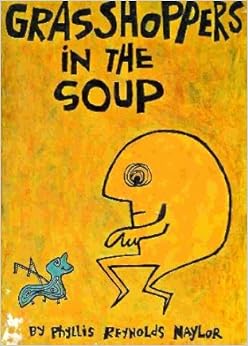
Book Review: Grasshoppers in the Soup by Phyllis Reynolds Naylor (1965)

In mid-October, I was lucky enough to be in the audience at one of my local libraries as Phyllis Reynolds Naylor kicked off her tour for the last Alice book, Now I’ll Tell You Everything. She mentioned in her remarks that she got her start as a short story author, and that her first book was a short story collection. Indeed, a little bit of Googling led me to the title of her first book, Grasshoppers in the Soup, which was published in 1965. This book is not widely available in my local libraries, but I was able to obtain a copy via inter-library loan.

The stories in Grasshoppers in the Soup are all about a group of teenagers, many of whom are members of the same youth group. Some stories are more overtly religious, involving pastors and church functions. Others have little to do with religion, and focus instead on issues like finding dates for special events, getting ready for work or college, impressing one’s classmates by hiding one’s true self, and interacting with overprotective parents. Each story, despite its main focus, has a humorous tone, and many of the stories end with a cute twist that leaves the reader smiling. One story, "P is for Principle", even manages to take on the issue of segregation as it applies to a restaurant where one young man has secured a job.

In some ways, there is a huge difference between these stories and Naylor’s writing in the Alice books. The teens in Grasshoppers in the Soup are neither angsty nor foul-mouthed. There is no discussion of sex, and often, stories with real moral dilemmas are left open-ended so the reader can discuss and resolve them, and the author does not have to provide a specific resolution. The Alice series is much more frank in its discussions of teen issues, and the tone is much less frivolous and much more contemporary. Still, though, one can see glimmers of Naylor’s future career in these stories. Alice attends a youth group. Alice has a large group of friends, many of whom pair off for dates or relationships throughout the series. Alice encounters discrimination, fights against her father’s rules, goes to camp, and has a first job. In all of her work for teens, it seems, Naylor is concerned with the day-to-day experiences kids have with their friends and with the milestones that make up the teen years. It is interesting to see how her interest in these things evolves and matures over time, but ultimately remains consistent.

It is also interesting to note that Naylor writes most of these short stories from the point of view of a male character. After reading so many books in Alice’s very obviously female voice, I enjoyed this change of pace and was impressed by how convincing her male narrators really are. On a related note, though, I will admit that it was difficult to keep track of the characters who recur throughout the story collection. Names like Ted, Chuck, and Marcia came up several times, but it was hard to tell whether they were just names for generic characters, or if I was meant to know these characters already from their involvement in previous stories. For the most part, I would say it is the plots that are significant to these stories, and not the characters, as most of them seemed very similar to one another, and more like vehicles for telling a story than people who grow and change significantly.

Grasshoppers in the Soup is very much a product of its time, and I don’t think many of the stories would ring true for today’s teens. That said, approached as an author study, reading this collection was very enlightening and gave me a new perspective on the many themes and topics that can provide good short story fodder, for a teen audience or any audience.

Sunday, February 23, 2014

Book Review: The Great Gilly Hopkins by Katherine Paterson (1978)

Galadriel “Gilly” Hopkins is eleven years old, and has been bounced from foster home to foster home. When she comes to Mrs. Trotter’s house, she decides right away to dislike Trotter, as well as her new foster brother William Ernest, Mr. Randolph, the elderly blind gentleman who lives next door, and her teacher, a black woman named Miss Harris. Instead of trying to make things work, Gilly plans to take advantage of any kindness shown to her and use it to find a way to be with her mother, Courtney, who sends occasional postcards but has not been around in eight years. As Gilly’s time with Trotter wears on, however, she becomes accustomed to the collection of people who make up her new family, and she begins to regret the letter she sent begging her mother to rescue her. Unfortunately, just when Gilly truly begins to feel at home, another change comes that prompts her to grow up quickly and realize her love for the people who have cared for her.

The Great Gilly Hopkins is a book I owned throughout childhood, but never read. It was recommended to me frequently, as I was a self-proclaimed realistic fiction reader, but Gilly, who is a mouthy, nervy, dishonest, and sometimes racist foster kid, was just a little bit too real for sheltered little old me. Lately, though, I have become curious about some of these so-called great books I outright refused to read as a kid, so I decided to give this one another chance. I can’t say that it’s my favorite, nor is it something I would have liked as a child, but I can now appreciate its value and understand why it received Newbery Honor recognition.

I think the great thing about this book is that it never becomes maudlin or sugary-sweet. Gilly is suitably rough around the edges for what she has been through, and her negative attitude is both appropriate to her situation and part of her charm, even when the reader doesn’t agree with everything she believes or claims to believe. Though Gilly obviously changes and overcomes some of her issues as the book progresses, the reader is never beaten over the head with Very Important Lessons or asked to swallow a cheesy message. Instead, Gilly’s life proceeds in a realistic, organic fashion, and the reader is left to piece together what she has learned on his or her own. The ending is satisfying, but not too tightly tied together, and the reader is left feeling hints of both hope and sadness.

I have reviewed quite a few books about foster families on this blog, and along with The Pinballs and The Story of Tracy Beaker, this one is one of the best. Each character is fully-realized and displays unique flaws. The story touches on some of the flaws in the foster care system as well as the disappointments kids face, but ultimately, it is not a story about foster care, or foster parents, but about one specific child and how her experience in a particular foster home shapes her personality, her attitude, and her future.

Though I’m not sure how I feel about it, I am curious about the upcoming 2014 film based on this book, which will star Kathy Bates as Trotter. While I think that is excellent casting, I wonder whether the film will be able to maintain the book’s subtleties, or if it will instead become a saccharine Hollywood drama about how a very special foster mom helps a very special girl. (I sincerely hope this can be avoided, as I think we are in desperate need of more well-made film adaptations of children’s books.)

Sunday, February 16, 2014

Book Review: Strider by Beverly Cleary (1991)

Strider is the sequel to Beverly Cleary’s 1984 Newbery Medal winning novel Dear Mr. Henshaw. Now that Leigh Botts is about to enter high school, he no longer writes to his favorite author, but instead he keeps a diary of the important things that happen to him. As high school begins, these events include finding a running dog named Strider, custody of whom he shares with his best friend, Barry, trying to hide Strider from his landlady whose opinion on pets is unknown, reconnecting with his dad, who has fallen into some bad luck, practicing for the track team, and working up the nerve to speak to Geneva, a fellow runner who has beautiful red hair.

Beverly Cleary writes wonderfully well about kids at a variety of ages, and I truly wish she had written more books about teens. Though Strider is not really a young adult novel, based on its tone and reading level, it still does a nice job of portraying a young teen boy in realistic situations. I was surprised by how old Leigh is in this book, but I was pleased that his experiences were so innocent, constructive, and educational. Not only is Leigh interesting to read about; he is also not a bad role model. The first book about Leigh becomes caught up almost entirely in his parents’ divorce. This sequel really branches out from that experience and focuses on Leigh as a whole person. I wouldn’t even consider this a dog story per se. Strider might be the catalyst for much of what happens to Leigh, but his changing life as he turns fourteen is really the story’s central theme.

Published in 1991, Strider is one of Cleary’s most recent books, followed by just three more titles, the last of which is 1999’s Ramona Forever. When compared with her older books, particularly the First Love series, and the Henry Huggins books, this one feels much more contemporary and relatable. It might be more relevant to me than to today’s kids, but kids who object to reading “old books” might feel a bit more comfortable with this one. I also think Strider is just a great boy book, which would work for readers who today are into Gary Paulsen’s stories about Kevin Spencer and James Patterson’s middle school books. I have always suggested Strider to dog lovers and Cleary fans, but after reading it, I really believe it can appeal to a wider variety of readers, whether they have read Dear Mr. Henshaw or not.