Galadriel “Gilly” Hopkins is eleven years old, and has been bounced from foster home to foster home. When she comes to Mrs. Trotter’s house, she decides right away to dislike Trotter, as well as her new foster brother William Ernest, Mr. Randolph, the elderly blind gentleman who lives next door, and her teacher, a black woman named Miss Harris. Instead of trying to make things work, Gilly plans to take advantage of any kindness shown to her and use it to find a way to be with her mother, Courtney, who sends occasional postcards but has not been around in eight years. As Gilly’s time with Trotter wears on, however, she becomes accustomed to the collection of people who make up her new family, and she begins to regret the letter she sent begging her mother to rescue her. Unfortunately, just when Gilly truly begins to feel at home, another change comes that prompts her to grow up quickly and realize her love for the people who have cared for her.
The Great Gilly Hopkins is a book I owned throughout childhood, but never read. It was recommended to me frequently, as I was a self-proclaimed realistic fiction reader, but Gilly, who is a mouthy, nervy, dishonest, and sometimes racist foster kid, was just a little bit too real for sheltered little old me. Lately, though, I have become curious about some of these so-called great books I outright refused to read as a kid, so I decided to give this one another chance. I can’t say that it’s my favorite, nor is it something I would have liked as a child, but I can now appreciate its value and understand why it received Newbery Honor recognition.
I think the great thing about this book is that it never becomes maudlin or sugary-sweet. Gilly is suitably rough around the edges for what she has been through, and her negative attitude is both appropriate to her situation and part of her charm, even when the reader doesn’t agree with everything she believes or claims to believe. Though Gilly obviously changes and overcomes some of her issues as the book progresses, the reader is never beaten over the head with Very Important Lessons or asked to swallow a cheesy message. Instead, Gilly’s life proceeds in a realistic, organic fashion, and the reader is left to piece together what she has learned on his or her own. The ending is satisfying, but not too tightly tied together, and the reader is left feeling hints of both hope and sadness.
I have reviewed quite a few books about foster families on this blog, and along with The Pinballs and The Story of Tracy Beaker, this one is one of the best. Each character is fully-realized and displays unique flaws. The story touches on some of the flaws in the foster care system as well as the disappointments kids face, but ultimately, it is not a story about foster care, or foster parents, but about one specific child and how her experience in a particular foster home shapes her personality, her attitude, and her future.
Though I’m not sure how I feel about it, I am curious about the upcoming 2014 film based on this book, which will star Kathy Bates as Trotter. While I think that is excellent casting, I wonder whether the film will be able to maintain the book’s subtleties, or if it will instead become a saccharine Hollywood drama about how a very special foster mom helps a very special girl. (I sincerely hope this can be avoided, as I think we are in desperate need of more well-made film adaptations of children’s books.)
Sunday, February 23, 2014
Sunday, February 16, 2014
Book Review: Strider by Beverly Cleary (1991)
Strider is the sequel to Beverly Cleary’s 1984 Newbery Medal winning novel Dear Mr. Henshaw. Now that Leigh Botts is about to enter high school, he no longer writes to his favorite author, but instead he keeps a diary of the important things that happen to him. As high school begins, these events include finding a running dog named Strider, custody of whom he shares with his best friend, Barry, trying to hide Strider from his landlady whose opinion on pets is unknown, reconnecting with his dad, who has fallen into some bad luck, practicing for the track team, and working up the nerve to speak to Geneva, a fellow runner who has beautiful red hair.
Beverly Cleary writes wonderfully well about kids at a variety of ages, and I truly wish she had written more books about teens. Though Strider is not really a young adult novel, based on its tone and reading level, it still does a nice job of portraying a young teen boy in realistic situations. I was surprised by how old Leigh is in this book, but I was pleased that his experiences were so innocent, constructive, and educational. Not only is Leigh interesting to read about; he is also not a bad role model. The first book about Leigh becomes caught up almost entirely in his parents’ divorce. This sequel really branches out from that experience and focuses on Leigh as a whole person. I wouldn’t even consider this a dog story per se. Strider might be the catalyst for much of what happens to Leigh, but his changing life as he turns fourteen is really the story’s central theme.
Published in 1991, Strider is one of Cleary’s most recent books, followed by just three more titles, the last of which is 1999’s Ramona Forever. When compared with her older books, particularly the First Love series, and the Henry Huggins books, this one feels much more contemporary and relatable. It might be more relevant to me than to today’s kids, but kids who object to reading “old books” might feel a bit more comfortable with this one. I also think Strider is just a great boy book, which would work for readers who today are into Gary Paulsen’s stories about Kevin Spencer and James Patterson’s middle school books. I have always suggested Strider to dog lovers and Cleary fans, but after reading it, I really believe it can appeal to a wider variety of readers, whether they have read Dear Mr. Henshaw or not.
Beverly Cleary writes wonderfully well about kids at a variety of ages, and I truly wish she had written more books about teens. Though Strider is not really a young adult novel, based on its tone and reading level, it still does a nice job of portraying a young teen boy in realistic situations. I was surprised by how old Leigh is in this book, but I was pleased that his experiences were so innocent, constructive, and educational. Not only is Leigh interesting to read about; he is also not a bad role model. The first book about Leigh becomes caught up almost entirely in his parents’ divorce. This sequel really branches out from that experience and focuses on Leigh as a whole person. I wouldn’t even consider this a dog story per se. Strider might be the catalyst for much of what happens to Leigh, but his changing life as he turns fourteen is really the story’s central theme.
Published in 1991, Strider is one of Cleary’s most recent books, followed by just three more titles, the last of which is 1999’s Ramona Forever. When compared with her older books, particularly the First Love series, and the Henry Huggins books, this one feels much more contemporary and relatable. It might be more relevant to me than to today’s kids, but kids who object to reading “old books” might feel a bit more comfortable with this one. I also think Strider is just a great boy book, which would work for readers who today are into Gary Paulsen’s stories about Kevin Spencer and James Patterson’s middle school books. I have always suggested Strider to dog lovers and Cleary fans, but after reading it, I really believe it can appeal to a wider variety of readers, whether they have read Dear Mr. Henshaw or not.
Sunday, February 9, 2014
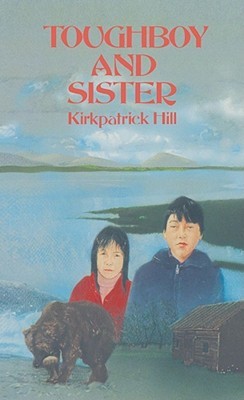
Book Review: Toughboy and Sister by Kirkpatrick Hill (1990)
Toughboy and Sister is a 1990 middle grade novel by Kirkpatrick Hill, author of one of my favorite books of the past year, Bo at Ballard Creek. When Toughboy and Sister’s mother dies in childbirth along with her baby, the two kids are left in the care of their father, who has a drinking problem. For a while things are okay, but once their dad begins drinking again, it’s just a matter of time before things go very wrong. While on a fishing trip away from their Alaskan village, Toughboy and Sister witness their father’s death, and then must struggle to survive on the food their father has collected and anything they can hunt or make themselves. With nothing but a battery-operated radio and a curious bear for company, the two kids find a way to survive not just emotional pain, but true physical hardship, until someone comes to their rescue.
This is a quick and powerful story, with a much more somber tone than Bo at Ballard Creek. It might be on the same reading level vocabulary-wise, but Toughboy and Sister definitely has more sophisticated subject matter which requires greater maturity on the part of the reader. While Bo at Ballard Creek focuses on the day-to-day fun of life in 1920s Alaska, this book focuses more on the dynamics in the relationship between two siblings in present-day (early 1990’s) Alaska and how their bond as siblings helps them overcome the difficulties they face. Though there are some mentions of the Athabascan culture and of the way people live in Toughboy and Sister’s village, this book is not as educational about Alaskan culture as Bo at Ballard Creek. Rather, the setting is secondary to the characters, and the characters’ surroundings are involved more as obstacles than as places to explore and enjoy.
Young readers looking for survival adventures similar to Hatchet and My Side of the Mountain will be drawn to Toughboy and Sister. Though the cover of the first edition (which is the one I read) is pretty dated-looking, and one that would not have caught my eye if I wasn’t already familiar with the author, I think a booktalk mentioning the death of the kids’ parents and a possible bear attack should be enough to get kids past that cover and into the story. The book has large type and is just over 100 pages, too, so reluctant readers and procrastinators might also consider it a good choice for a book report, especially one that is due in just a day or two. The short chapters and compelling subject matter also make it a manageable read-aloud for busy fourth and fifth grade classrooms.
This is a quick and powerful story, with a much more somber tone than Bo at Ballard Creek. It might be on the same reading level vocabulary-wise, but Toughboy and Sister definitely has more sophisticated subject matter which requires greater maturity on the part of the reader. While Bo at Ballard Creek focuses on the day-to-day fun of life in 1920s Alaska, this book focuses more on the dynamics in the relationship between two siblings in present-day (early 1990’s) Alaska and how their bond as siblings helps them overcome the difficulties they face. Though there are some mentions of the Athabascan culture and of the way people live in Toughboy and Sister’s village, this book is not as educational about Alaskan culture as Bo at Ballard Creek. Rather, the setting is secondary to the characters, and the characters’ surroundings are involved more as obstacles than as places to explore and enjoy.
Young readers looking for survival adventures similar to Hatchet and My Side of the Mountain will be drawn to Toughboy and Sister. Though the cover of the first edition (which is the one I read) is pretty dated-looking, and one that would not have caught my eye if I wasn’t already familiar with the author, I think a booktalk mentioning the death of the kids’ parents and a possible bear attack should be enough to get kids past that cover and into the story. The book has large type and is just over 100 pages, too, so reluctant readers and procrastinators might also consider it a good choice for a book report, especially one that is due in just a day or two. The short chapters and compelling subject matter also make it a manageable read-aloud for busy fourth and fifth grade classrooms.
Sunday, February 2, 2014
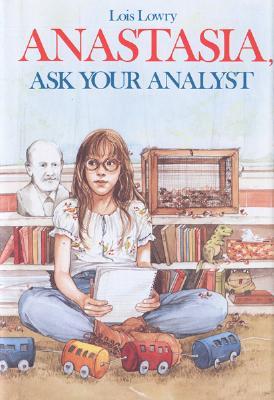
Book Review: Anastasia, Ask Your Analyst by Lois Lowry (1984)
Anastasia is now thirteen years old, and between her annoying family and the unpredictability of the gerbils she brought home for her science project, she really feels like she could benefit from some time in therapy. Her parents recognize her dramatics as part and parcel of puberty, and they refuse to pay for any counseling, so Anastasia takes matters into her own hands. She buys a bust of Sigmund Freud in whom she confides all of her problems big and small, and whose assistance seems helpful despite his silence.
This book, like the others in the series so far, is essentially a literary family sit-com. It focuses on Anastasia’s day-to-day interactions with her academic parents, precocious little brother and various classmates, putting a humorous spin on everything from homework to early teen angst. Though Anastasia ages from book to book, she always remains uniquely herself, and I am impressed by how well Lowry must know her character in order to write so effectively about the changes she undergoes from year to year. I particularly love that Anastasia is so articulate and self-aware. I laughed out loud when she confessed to her mother that she hated her and then asked for a cure. It’s so refreshing to see a fictional character whose relationship with her mother is that honest, and whose conversations with her parents are so frank.
The highlight of this book is Anastasia’s struggle to contain her gerbils, which begin as a pair and quickly grow to a family of eleven. Though class pets getting loose in family homes is a common occurrence in many children’s books, few authors handle the situation with such clever writing or with such amusing collaboration between teen and toddler siblings. Some of the best parts of this book involve Sam and Anastasia secretly working together to keep their mother from learning there are rodents loose in her home. Also interesting are Anastasia’s notes on her science project, which follow a similar format to her likes and dislikes list back in the first book, Anastasia Krupnik.
Though this book has one of the worst covers of the series so far, it is one of the more memorable stories. Girls who enter puberty in the middle grade years will especially enjoy Anastasia’s candid descriptions of the experience, and they will laugh along as she confides in “Sigmund,” chases down gerbils and struggles to pin down what it means to be normal.
This book, like the others in the series so far, is essentially a literary family sit-com. It focuses on Anastasia’s day-to-day interactions with her academic parents, precocious little brother and various classmates, putting a humorous spin on everything from homework to early teen angst. Though Anastasia ages from book to book, she always remains uniquely herself, and I am impressed by how well Lowry must know her character in order to write so effectively about the changes she undergoes from year to year. I particularly love that Anastasia is so articulate and self-aware. I laughed out loud when she confessed to her mother that she hated her and then asked for a cure. It’s so refreshing to see a fictional character whose relationship with her mother is that honest, and whose conversations with her parents are so frank.
The highlight of this book is Anastasia’s struggle to contain her gerbils, which begin as a pair and quickly grow to a family of eleven. Though class pets getting loose in family homes is a common occurrence in many children’s books, few authors handle the situation with such clever writing or with such amusing collaboration between teen and toddler siblings. Some of the best parts of this book involve Sam and Anastasia secretly working together to keep their mother from learning there are rodents loose in her home. Also interesting are Anastasia’s notes on her science project, which follow a similar format to her likes and dislikes list back in the first book, Anastasia Krupnik.
Though this book has one of the worst covers of the series so far, it is one of the more memorable stories. Girls who enter puberty in the middle grade years will especially enjoy Anastasia’s candid descriptions of the experience, and they will laugh along as she confides in “Sigmund,” chases down gerbils and struggles to pin down what it means to be normal.
Tuesday, January 28, 2014
Book Review: Flora & Ulysses: The Illuminated Adventures by Kate DiCamillo (2013)
Flora is a cynic who reads comic books, despite her mother’s insistence that she read literature. Ulysses is a squirrel who is accidentally sucked into a vacuum cleaner. When Flora saves his life using mouth-to-mouth resuscitation, she discovers that Ulysses has superpowers - and specifically, the power to type poetry. Though her next door neighbor who owns the vacuum cleaner and her own father are fine with her keeping the squirrel, Flora finds that she must save Ulysses from her own mother, who would prefer to have him destroyed.
At first, this quirky story seems like a huge departure for Kate DiCamillo, whose books include heartwarming favorites like Bink and Gollie, The Tale of Despereaux, and Because of Winn Dixie. Looking closely, however, it becomes clear that this book is actually quite similar to all three of those titles. The text plays with language as DiCamillo does in Bink and Gollie. The story is partly a fairy tale, like The Tale of Despereaux. And above all, the main character is a lonely girl, just like Winn Dixie’s Opal, whose very special animal friend is the key to breaking her out of her shell and helping her to make friends and trust those around her. The style might be slightly different, but there is no doubt who wrote this book.
Like so many kids’ books these days, this one is partially illustrated with comic book panels. Though I suspect this feature will draw kids into the story, I didn’t think those panels were all that necessary, and I would have been just as happy to have DiCamillo write narration for those scenes. I like the illustrator’s style, and I especially enjoyed the sense of Flora’s personality that I got from her facial expressions, but I felt as though I would have liked some aspects of the book more had I been allowed to imagine them for myself. Especially jarring was the difference between Flora’s mother’s appearance in the illustrations and the version I conjured in my imagination. I had basically imagined a whole different character and found it difficult to reconcile her with what the illustrator provided.
All in all, I think this is an interesting book, but perhaps not as innovative as it appears at first glance. Kids who are interested in superheroes and super powers will probably enjoy the story. I do question whether a superhero squirrel is really what kids are looking for, but Spiderman and Batman do okay and they’re not the most likely creatures to be heroes either. I was a little disappointed that the squirrel’s powers come on so suddenly, with no explanation as to how being sucked up by a vacuum causes him to develop them, but I suspect I am in the minority on that point. Most readers will be happy to go along for the somewhat silly ride and just enjoy Ulysses and his squirrel poems. I also have to admit that I think “Holy bagumba!” is a great phrase, and I’m grateful to this book for introducing it into my vocabulary.
Flora & Ulysses: The Illuminated Adventures will appeal to boys and girls, and especially to those readers who enjoy comics, animals, and magical realism.
At first, this quirky story seems like a huge departure for Kate DiCamillo, whose books include heartwarming favorites like Bink and Gollie, The Tale of Despereaux, and Because of Winn Dixie. Looking closely, however, it becomes clear that this book is actually quite similar to all three of those titles. The text plays with language as DiCamillo does in Bink and Gollie. The story is partly a fairy tale, like The Tale of Despereaux. And above all, the main character is a lonely girl, just like Winn Dixie’s Opal, whose very special animal friend is the key to breaking her out of her shell and helping her to make friends and trust those around her. The style might be slightly different, but there is no doubt who wrote this book.
Like so many kids’ books these days, this one is partially illustrated with comic book panels. Though I suspect this feature will draw kids into the story, I didn’t think those panels were all that necessary, and I would have been just as happy to have DiCamillo write narration for those scenes. I like the illustrator’s style, and I especially enjoyed the sense of Flora’s personality that I got from her facial expressions, but I felt as though I would have liked some aspects of the book more had I been allowed to imagine them for myself. Especially jarring was the difference between Flora’s mother’s appearance in the illustrations and the version I conjured in my imagination. I had basically imagined a whole different character and found it difficult to reconcile her with what the illustrator provided.
All in all, I think this is an interesting book, but perhaps not as innovative as it appears at first glance. Kids who are interested in superheroes and super powers will probably enjoy the story. I do question whether a superhero squirrel is really what kids are looking for, but Spiderman and Batman do okay and they’re not the most likely creatures to be heroes either. I was a little disappointed that the squirrel’s powers come on so suddenly, with no explanation as to how being sucked up by a vacuum causes him to develop them, but I suspect I am in the minority on that point. Most readers will be happy to go along for the somewhat silly ride and just enjoy Ulysses and his squirrel poems. I also have to admit that I think “Holy bagumba!” is a great phrase, and I’m grateful to this book for introducing it into my vocabulary.
Flora & Ulysses: The Illuminated Adventures will appeal to boys and girls, and especially to those readers who enjoy comics, animals, and magical realism.
Sunday, January 19, 2014
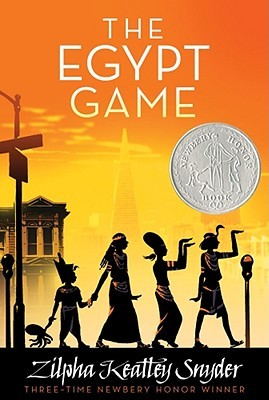
Book Review: The Egypt Game by Zilpha Keatley Snyder (1967)
When April Hall moves in with her grandmother while her mother remains in Hollywood, the first kids she meets are Melanie Ross and her brother, Marshall. April and Melanie appear to be quite different from each other, but they soon bond over a mutual fascination with Egyptian history. Each afternoon, the two girls and Marshall gather in the yard behind the A-Z Antiques and Curio Shop to play the Egypt Game. At first, the game consists of simple rituals and ceremonies which the girls invent and perform in costume. Later, as more members join their group, their activities expand to include writing in hieroglyphics and attempting to gain information from an oracle. When strange things begin to happen to members of their group, however, April and Melanie wonder how much of the Egypt Game is imagined and how much is real.
The Egypt Game was first published in 1967, and it was awarded a Newbery Honor in 1968. Like Jennifer, Hecate, Macbeth, William McKinley, and Me, Elizabeth by E.L. Konigsburg and Afternoon of the Elves by Janet Taylor Lisle, it explores the power of imagination and the exciting adventures kids can have in their own backyards when left to their own devices. As I read this book, I kept thinking that it represents everything I like to see in a middle grade novel. These days, it seems like middle grade is treated as a stepping stone to YA, rather than as a reading level unto itself. In many situations, middle grade has started to refer to middle school, and the focus has shifted from tales of family, friendship and imagination to sordid stories about bullies, ostracization, dating, and family dysfunction. Reading The Egypt Game reminded me that there are many other topics of interest to kids in the 8-12 age range, and that even fifth and sixth graders still like to imagine and pretend. I’d like to see more contemporary middle grade novels living up to the standard set by this book.
There are lots of lovely details in this story that bring it and its characters fully to life. Marshall is never seen without his stuffed octopus named Security. April tries to impress people and simultaneously keep them at bay by wearing fake eyelashes, which she only sheds after she becomes comfortable with her new friends. Melanie enjoys cutting photos of people out of magazines and using them to tell stories which she hides in the pages of a special book on her shelf. Each character has a role in the larger group of Egyptians, but each is also an individual whose personality and quirks contribute to the overall story.
For a book going on 50 years old, The Egypt Game holds up really well. No matter how many years pass, children will always enjoy making up their own games and imagining themselves in various roles, and this book really celebrates these unique childhood experiences in a way that resonates with multiple generations. Though there is a sequel, The Gypsy Game, and I plan to read it, I would argue that The Egypt Game is pretty much perfect on its own, and I think it will be a tough act to follow, even for its own author.
The Egypt Game was first published in 1967, and it was awarded a Newbery Honor in 1968. Like Jennifer, Hecate, Macbeth, William McKinley, and Me, Elizabeth by E.L. Konigsburg and Afternoon of the Elves by Janet Taylor Lisle, it explores the power of imagination and the exciting adventures kids can have in their own backyards when left to their own devices. As I read this book, I kept thinking that it represents everything I like to see in a middle grade novel. These days, it seems like middle grade is treated as a stepping stone to YA, rather than as a reading level unto itself. In many situations, middle grade has started to refer to middle school, and the focus has shifted from tales of family, friendship and imagination to sordid stories about bullies, ostracization, dating, and family dysfunction. Reading The Egypt Game reminded me that there are many other topics of interest to kids in the 8-12 age range, and that even fifth and sixth graders still like to imagine and pretend. I’d like to see more contemporary middle grade novels living up to the standard set by this book.
There are lots of lovely details in this story that bring it and its characters fully to life. Marshall is never seen without his stuffed octopus named Security. April tries to impress people and simultaneously keep them at bay by wearing fake eyelashes, which she only sheds after she becomes comfortable with her new friends. Melanie enjoys cutting photos of people out of magazines and using them to tell stories which she hides in the pages of a special book on her shelf. Each character has a role in the larger group of Egyptians, but each is also an individual whose personality and quirks contribute to the overall story.
For a book going on 50 years old, The Egypt Game holds up really well. No matter how many years pass, children will always enjoy making up their own games and imagining themselves in various roles, and this book really celebrates these unique childhood experiences in a way that resonates with multiple generations. Though there is a sequel, The Gypsy Game, and I plan to read it, I would argue that The Egypt Game is pretty much perfect on its own, and I think it will be a tough act to follow, even for its own author.
Sunday, January 12, 2014
Reading Through History: Emily's Runaway Imagination by Beverly Cleary (1961)
![]() |
I didn’t realize that Beverly Cleary had ever written any historical fiction, so this book was a pleasant surprise. I also enjoyed the fact that the story is at least partly autobiographical, especially knowing that Beverly Cleary grew up to be not just a children’s author, but a librarian too. It’s neat to see how real life influences her work, and of course, as a librarian, it’s interesting to think about the process of establishing a brand-new library for a small town. I really enjoyed reading of Emily’s persistence in helping to raise money for the library, and I related to her desire to read that one book she just can’t get her hands on, which in her case is Black Beauty.
Readers looking for upbeat and uplifting historical fiction that dwells on the fun of living rather than the many tragedies that befell our ancestors will enjoy this book immensely. Some might have trouble swallowing Fong Quock’s language barrier, where he pronounces Rs as Ls, but I actually think Cleary is pretty respectful of his character, and that her description of his speech pattern is a product of the time in which she was writing, and not the result of any desire on her part to poke fun at him. Fong Quock actually becomes quite a hero in the book, and he adds a bit of cultural diversity to the story that is otherwise strongly lacking.
Though this is not Cleary’s best-known work, it is every bit as well-written as the beloved Henry Huggins and Ramona books, and it gives readers a stronger sense of her varied talents as a writer. The episodic nature of the book makes it a natural choice for classroom or bedtime read-alouds, as each chapter comes to a natural conclusion that does not leave the reader hanging. Librarians everywhere should also read this book, if for no other reason than to see a new library coming together to benefit a community in need. Though it might be buried on the shelves among a thousand copies of the Ramona books, this book is worth hunting down and reading. Most readers old and young will find their imaginations running right alongside Emily’s, enjoying every moment of her story.
Subscribe to:
Posts (Atom)