The Cybil War is an Apple paperback published in 1981. The story is that of an elementary school love triangle wherein best friends Simon and Tony fight to win the affections of their classmate, Cybil Ackerman. Simon has been in love with Cybil since she was kind to him after his father moved out, but Tony, a notorious liar who isn't even allowed to attend his own sister's birthday party, is in it more for the competition. Cybil herself is more than worth the fight - she's smart and generous and compassionate, and possesses an inexplicable ability to rise above the antics of her classmates, even when they aim to hurt her feelings. Though the right choice for Cybil is pretty clear early on, it's still fun following the story to its satisfying conclusion.
I think this book captures the feelings of early crushes in a very innocent and pure way. There is no real romance in this book; rather, the love Simon feels for Cybil is a very noble form of admiration where he regards her with awe more than anything else. There are some references to dating, which, even 20 years ago, was not something that happened among elementary school kids I knew. There was some "going out" but that usually just meant holding hands and spending recess together, not going to the movies, as they do in this book. The storyline matches up better with sit-coms about school life than it does with real life. Maybe kids went on dates in 1981, but it seems like it happened much more in pop culture than in reality. The book also includes a pet show, which is definitely the kind of thing I think kids dream of having, even if they never actually do it. I can still imagine that piece of the story taking place in a contemporary book.
Because this book is by Betsy Byars, I expected it to be well-written, and I was not disappointed. I was also pleasantly surprised when I realized the book is still in print and available as an e-book! It's one of the few books about love that can appeal to boys or girls - and maybe even more to boys, given the male friendship at the center of the plot. The cover could use an update, but otherwise, I think the story is a perfect choice for fourth-, fifth-, and sixth-graders who are taking their first tentative steps toward finding love.
Sunday, February 26, 2012
Tuesday, February 21, 2012
Book Review: Mo Wren, Lost and Found by Tricia Springstubb (2011)
Mo Wren, Lost and Found is the sequel to What Happened on Fox Street, and it sees the Wren family beginning its new life in a new part of town. Dad works hard to make his dream restaurant a reality, while Dottie adjusts surprisingly well to life in a new school. Mo seems to be the only one who is lost, as she copes with being away from Da, Mercedes, Pi, and everything else she loved about Fox Street.
Like the first book, this is a very introspective title, where much of the action of the plot takes place inside Mo’s mind, as she deals with her feelings on various topics. Her new neighborhood is filled with interesting people, each of whom, over time, becomes important to Mo, even in spite of her objections to the move. I don’t know if the book really covered anything new as compared with the first book, but I did enjoy finding out what happened to the Wrens and seeing how things ultimately turned out for all of them. A pet lizard, a used sweatshirt, a curse, and a laundromat also figure heavily into the plot, as does the new family in the house on Fox street, an unusual boy named Shawn, and a surprise snowstorm.
I’d recommend this book to readers who enjoyed What Happened on Fox Street, as well as Susan Patron’s Hard Pan Trilogy, and Karen Day’s A Million Miles from Boston, where characters must also deal with major life changes and figure out how to navigate adult problems.
Monday, February 13, 2012
Book Review: Troublemaker by Andrew Clements (2011)
Clay Hensley is always in trouble. He likes the attention it gets him at school, but more than that, he likes having tales of mischief to tell his older brother, Mitch. Mitch has just spent some time in jail, however, and when he comes home, he starts getting on Clay’s case, asking him to work on his behavior and promise not to get in so much trouble anymore. Clay would do anything to please his big brother, but is it too late to make such a drastic change?
This school story by the master of contemporary school stories addresses an important topic in a straightforward, entertaining, and positive manner. Though Clay is difficult to discipline in school, and has a tough relationship with the principal, he’s also a talented artist whose abilities are recognized by the art teacher, and possesses an interesting personality, whose merits are recognized by the principal’s secretary. Though Clay isn’t headed down a very promising path when the book begins, he still has a lot going for him, which makes the reader sympathize with him and hope for his success.
Clements’s story does clearly have a moral, but it doesn’t come across in a preachy way. Clay makes his own decisions every step of the way, and it’s through his feelings that the reader comes to understand the importance of cleaning up his act and not winding up in jail as his brother did. I’m not sure this book alone would be enough to convince a kid who acts up in class to reconsider his behavior, but I do think the story gives well-behaved kids some insight into the minds of those troublemakers they know in their classes. Ultimately, the story demonstrates that no one is ever just one thing, and that each of us is the master of our own destiny.
In addition to Troublemaker, I'd also recommend checking out Dexter the Tough, a chapter book by Margaret Peterson Haddix which covers very similar subject matter.
This school story by the master of contemporary school stories addresses an important topic in a straightforward, entertaining, and positive manner. Though Clay is difficult to discipline in school, and has a tough relationship with the principal, he’s also a talented artist whose abilities are recognized by the art teacher, and possesses an interesting personality, whose merits are recognized by the principal’s secretary. Though Clay isn’t headed down a very promising path when the book begins, he still has a lot going for him, which makes the reader sympathize with him and hope for his success.
Clements’s story does clearly have a moral, but it doesn’t come across in a preachy way. Clay makes his own decisions every step of the way, and it’s through his feelings that the reader comes to understand the importance of cleaning up his act and not winding up in jail as his brother did. I’m not sure this book alone would be enough to convince a kid who acts up in class to reconsider his behavior, but I do think the story gives well-behaved kids some insight into the minds of those troublemakers they know in their classes. Ultimately, the story demonstrates that no one is ever just one thing, and that each of us is the master of our own destiny.
In addition to Troublemaker, I'd also recommend checking out Dexter the Tough, a chapter book by Margaret Peterson Haddix which covers very similar subject matter.
Sunday, February 5, 2012
Book Review: Theater Shoes by Noel Streatfeild (1944)
Theater Shoes is Noel Streatfeild's fifth book for children, and it was originally published with the title Curtain Up in 1944. Though it came out eight years after Ballet Shoes, it is essentially a sequel, focusing on the same dance academy at which Pauline, Petrova, and Posy Fossil studied in the 1930s. The main characters of this story, Sorrel, Mark, and Holly Forbes, are the grandchildren of a famous actress and also the beneficiaries of scholarships funded by the three Fossil girls, (who are now quite grown up and doing very well for themselves, despite the hardships of World War II.) Favorite characters from Ballet Shoes, including Madame Fidolia, Miss Jay, and Winifred, figure heavily into this story as well, but the Forbes children are very much their own personalities, and their yearning for their father who is missing in action, their uncertainty regarding their strange grandmother, and their rivalry with stuck-up cousin Miranda are the driving forces behind the plot. Though there are many similarities to the formula used to write Ballet Shoes, this book is also its own entity, with its own strong characters and narrative voice.
This book was not historical fiction when it was published, as much of it takes place in 1943, just one year before its publication, but it reads as such today. References to bombing in London, to coupons used to buy things, and to the military men for whom the children perform concerts embed the story firmly in the time period and actually do quite a nice job of illustrating World War II England for today's children, in terms they can understand, and in a way that makes the historical events mentioned accessible and interesting. I think this book is also a bit more believable than Ballet Shoes. Ballet Shoes reads more like a fairy tale, with all these improbable twists and turns leading the Fossils to great fame. The Forbes children are more down-to-Earth, and their experiences more realistic, and more likely. Sorrel, especially, felt like a very real girl with real flaws and concerns. It was easy to put myself in her place and imagine the world of the academy, and Miranda's snobbery, from her point of view. Mark, too, was an interesting addition to the story, because he introduces a male point of view and represents a segment of the population - male dancers - which is often ignored by children's fiction. Of the three, only Holly seemed a bit flat, almost as though she provided comic relief and not much else.
Another thing that made reading this book so enjoyable was that I listened to the audiobook, which is narrated by Elizabeth Sastre. She also narrates the version of Ballet Shoes which I listened to and I can't imagine anyone else doing a better job. She introduces these subtle nuances of personality just in the voices she uses for each of the characters. Her accent is also very easy to understand, but immerses the listener completely into the way English is spoken in England, which is important to the overall appreciation of this book.
This is one of the older books I've blogged about, but it's one of the ones that holds up the best. The drama between Miranda and Sorrel reads like many tween novels being published today and definitely zeroes in on the kind of friendship stories girls in the middle grade age range love to read. It's also a great choice for girls who are not yet into romance and dating, but instead like to read about girls having life experiences, spending time with their families, and working hard at becoming better performers.
This book was not historical fiction when it was published, as much of it takes place in 1943, just one year before its publication, but it reads as such today. References to bombing in London, to coupons used to buy things, and to the military men for whom the children perform concerts embed the story firmly in the time period and actually do quite a nice job of illustrating World War II England for today's children, in terms they can understand, and in a way that makes the historical events mentioned accessible and interesting. I think this book is also a bit more believable than Ballet Shoes. Ballet Shoes reads more like a fairy tale, with all these improbable twists and turns leading the Fossils to great fame. The Forbes children are more down-to-Earth, and their experiences more realistic, and more likely. Sorrel, especially, felt like a very real girl with real flaws and concerns. It was easy to put myself in her place and imagine the world of the academy, and Miranda's snobbery, from her point of view. Mark, too, was an interesting addition to the story, because he introduces a male point of view and represents a segment of the population - male dancers - which is often ignored by children's fiction. Of the three, only Holly seemed a bit flat, almost as though she provided comic relief and not much else.
Another thing that made reading this book so enjoyable was that I listened to the audiobook, which is narrated by Elizabeth Sastre. She also narrates the version of Ballet Shoes which I listened to and I can't imagine anyone else doing a better job. She introduces these subtle nuances of personality just in the voices she uses for each of the characters. Her accent is also very easy to understand, but immerses the listener completely into the way English is spoken in England, which is important to the overall appreciation of this book.
This is one of the older books I've blogged about, but it's one of the ones that holds up the best. The drama between Miranda and Sorrel reads like many tween novels being published today and definitely zeroes in on the kind of friendship stories girls in the middle grade age range love to read. It's also a great choice for girls who are not yet into romance and dating, but instead like to read about girls having life experiences, spending time with their families, and working hard at becoming better performers.
Thursday, February 2, 2012
All About the Babymouse Series
Here is what I learned after reading several Babymouse titles:First of all, Babymouse is not a baby. I honestly wish I'd paid more attention and picked up on that fact sooner, because it would have made me much more interested in reading this series. As it turns out, Babymouse is in middle school and has a bit of a middle school attitude. She dislikes school, has an active imagination, and frequently spouts the pessimistic phrase, "Typical," when something doesn't go her way. She reminds me of AJ from the Weird School books and even a little bit of Junie B. Jones. I understand now why she's so popular.
The illustrations in the Babymouse books are somewhat similar to those in the Fashion Kitty series in that they are entirely pink and black. From what I can gather, though, the pinkness of the books doesn't turn off boy readers. In fact, I think Babymouse's attitude and the graphic format of the books draws in boy readers, especially reluctant ones.
The narrator is a character in each book. As in Disney's Winnie-the-Pooh, the narrator tells the story and also interacts with Babymouse, arguing with her and sometimes poking fun at her in a somewhat ironic tone. Because of this relationship with the narrator, I kept thinking of Babymouse as a grown-up version of the mouse in the The Little Mouse, The Red Ripe Strawberry, and the Big, Hungry Bear. The tone is very similar.
Whereas the Fashion Kitty books are more about girl power, Babymouse is more about relating universal middle school experiences in a funny way. In that sense, the series compares well to Amelia Rules, where the characters also use their imaginations to combat life's difficulties. Funny visual gags really add to the universal appeal and make the mundane seem interesting and adventurous.
Sunday, January 29, 2012
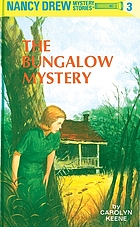
Book Review: The Bungalow Mystery by Carolyn Keene (1930)
I am quite sure that The Secret at Solaire, is not the only Nancy Drew book I read in childhood, but it was the only one I could remember, so I thought I owed it to myself to also read one of the original titles. I wanted to see how the 1993 Nancy compared to 1930 Nancy, and to get a sense of what the series was really all about. Because my fiance owns a 1930 edition of The Bungalow Mystery that I could easily get my hands on, that is the one I chose to read.
The story begins with a sudden rainstorm, which overturns a motorboat containing Nancy and her friend Helen Corning. The girls are rescued by a stranger, Laura Pendleton, whose mother has recently died. Laura has been entrusted to a guardian named Jacob Aborn, but as she soon realizes, he does not have her best interests at heart. Nancy, determined to repay Laura for saving her life, hides the girl at her house in River Heights, and heads out to spy on Jacob Aborn's bungalow to find out what he's really up to.
Because the book was written in 1930, some of the language - especially slang - obviously sounds dated to contemporary ears. In the first chapter or two, the author uses the word chum many times, to describe Helen Corning's relationship to Nancy, and each and every time, it made me giggle a little bit, because it sounded so silly. (I also think the author could have used another word at least a few times. I counted four uses of chum on just one page at one point.) I also thought the conversations Nancy has with some of the characters were very stiff. They lacked contractions and seemed overly polite, as though each character was a perfect robot with perfect manners.
Indeed, Nancy Drew is completely perfect in every way. She's a great swimmer. She can put chains on the wheels of her roadster. (Heck, she has a roadster.) She isn't afraid of intimidating men, she finds ways to get out of danger again and again, and she never hesitates to take someone under her wing and into her home for protection. I don't think she has a single flaw, and I think the only reason readers don't totally hate her is that she does so many cool things. Before the mystery even starts, Nancy has already survived two near-death storm-related experiences, and by the end of the story, she's been locked in a closet, knocked out, tied up, and left for dead in a dark basement. And every single time she comes out of the danger unscathed. What girl - in 1930 or now - doesn't want that kind of awesome, exciting life?
I enjoyed The Bungalow Mystery much more than The Secret at Solaire, mainly because the mystery was more suspenseful, and better-crafted, and because the older title had a lot of charm and history behind it that kept me interested and immersed me in a world quite unlike my own. Though I doubt I'll review them, I definitely want to read more of the books from the original Nancy Drew series.
The story begins with a sudden rainstorm, which overturns a motorboat containing Nancy and her friend Helen Corning. The girls are rescued by a stranger, Laura Pendleton, whose mother has recently died. Laura has been entrusted to a guardian named Jacob Aborn, but as she soon realizes, he does not have her best interests at heart. Nancy, determined to repay Laura for saving her life, hides the girl at her house in River Heights, and heads out to spy on Jacob Aborn's bungalow to find out what he's really up to.
Because the book was written in 1930, some of the language - especially slang - obviously sounds dated to contemporary ears. In the first chapter or two, the author uses the word chum many times, to describe Helen Corning's relationship to Nancy, and each and every time, it made me giggle a little bit, because it sounded so silly. (I also think the author could have used another word at least a few times. I counted four uses of chum on just one page at one point.) I also thought the conversations Nancy has with some of the characters were very stiff. They lacked contractions and seemed overly polite, as though each character was a perfect robot with perfect manners.
Indeed, Nancy Drew is completely perfect in every way. She's a great swimmer. She can put chains on the wheels of her roadster. (Heck, she has a roadster.) She isn't afraid of intimidating men, she finds ways to get out of danger again and again, and she never hesitates to take someone under her wing and into her home for protection. I don't think she has a single flaw, and I think the only reason readers don't totally hate her is that she does so many cool things. Before the mystery even starts, Nancy has already survived two near-death storm-related experiences, and by the end of the story, she's been locked in a closet, knocked out, tied up, and left for dead in a dark basement. And every single time she comes out of the danger unscathed. What girl - in 1930 or now - doesn't want that kind of awesome, exciting life?
I enjoyed The Bungalow Mystery much more than The Secret at Solaire, mainly because the mystery was more suspenseful, and better-crafted, and because the older title had a lot of charm and history behind it that kept me interested and immersed me in a world quite unlike my own. Though I doubt I'll review them, I definitely want to read more of the books from the original Nancy Drew series.
Sunday, January 8, 2012
Reading Through History: Betsy-Tacy by Maud Hart Lovelace (1940)
Betsy-Tacy is a 1940 children's novel written by Maud Hart Lovelace and illustrated by Lois Lenski. The main characters are two little girls who grow up across the street from one another in 1890s Minnesota. The first time they meet, the girls have a misunderstanding that nearly jeopardizes their chances of being friends, but after Betsy invites Tacy to her birthday party, they become inseparable. Betsy and Tacy, who are often called by one name, Betsy-Tacy, have wonderful adventures eating supper on the hill at the end of their street, trying to outsmart their big sisters Katie and Julia, and selling sand to the neighbors. They also band together in the face of a tragedy in Tacy's family, and toward the end of the book, make a new friend, named Tib.
Like the works of Carolyn Haywood and Beverly Cleary, Betsy-Tacy portrays a world of childhood innocence and imagination that doesn't really seem to be typical of contemporary children's books. Not only is the story old-fashioned and clearly set in the past, it's also filled with the possibilities of an idealized world where children don't need constant supervision and can feel free to wander the neighborhood without fearing for their safety. There is no question that the story is dated. The mothers have calling cards which they deliver to friends' houses, the main mode of transportation is a horse-drawn carriage, and all the children attend school in a schoolhouse. But it is this historical context that makes the book so charming.
The writing itself also transcends time. The text is clearly written at a child's level. I was able to get inside the minds of Betsy and Tacy as well as I could Ramona's mind or Carolyn Haywood's Betsy's mind. They might live in another time and place, but the thought processes of these girls are universal, as are many of their experiences, from the first day of school, to playing with paper dolls to anticipating a new baby in the family. Lovelace tapped into the way children think and behave, and even if kids growing up in the 21st century don't understand every historical reference, they will see themselves in Betsy and Tacy nonetheless.
Finally, I love the illustrations by Lois Lenski, which depict the style of dress, home decorating schemes, and schoolhouse furniture of the time period. The drawings perfectly match the tone and style of the story and further immerse the reader in the nostalgic atmosphere of this fictional world.
Betsy-Tacy is the first book in a series that follows Betsy through to adulthood. Learn more about Betsy and Tacy and their creator on the website for the Betsy-Tacy Society.
Subscribe to:
Posts (Atom)